



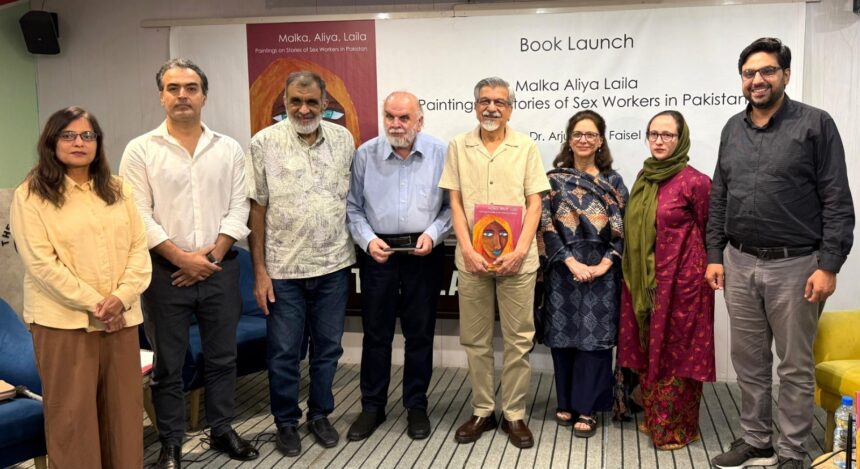
The launch of Malka Aliya Laila: Paintings on Stories of Sex Workers in Pakistan brought together artists, academics, writers and students for an emotionally charged evening that linked public health research, visual art and the lived experiences of marginalized women. The book and its accompanying exhibition present paintings that aim to humanize sex workers, portraying their pain, resilience and dignity beyond data points or sensationalized imagery.
The event, hosted at The Black Hole and organized by Gallery 6 in collaboration with the East-West Center Alumni Association – Islamabad Chapter, featured a multimedia presentation of selected paintings and a panel discussion on representation and ethics. Attendees responded to the collection’s raw emotional power and the intersection of medical research and visual expression that informs the work.
Faiz Muhammad Paracha, senior journalist and Secretary General of EWCA-IC, moderated the program and introduced the author, highlighting Dr. Arjumand Faisel’s varied career. Paracha described Faisel as someone who has “lived many lives in one,” noting his early start in journalism, his training and practice as a medical doctor, postgraduate work in public health in Pakistan and the United States, and his role as founder of Gallery 6 and the Arjumand Painting Award.
The dual focus on health and art is central to Malka Aliya Laila. Paracha emphasized that while sex workers have often been depicted through the male gaze in art, Dr. Faisel’s paintings treat them as human beings rather than objects, drawing a parallel to Saadat Hasan Manto’s literary depictions that restored dignity and complexity to ostracized figures.
Art critic Cosima Brand offered an emotional response to the work, saying she contemplated the paintings “with eyes brimming with tears” and praising their ability to speak directly to the soul. Brand noted that Dr. Faisel’s training in data collection for the Ministry of Health could not fully capture the human realities he encountered, and that the paintings provide space for each injustice, defiant stare and quietly proud woman to be seen.
Dr. Faisel described the origin of the book in his early 2000s HIV/AIDS research, recalling that many encounters were “unbearable” and could not be reduced to statistics. He turned to Expressionism to translate those experiences into paint, focusing less on likeness and more on conveying inner truth — pain, resilience and dignity — through color, form and gesture.
The presentation was followed by a discussion on the ethics of representing marginalized women and the emotional toll such work takes on the artist. Participants debated responsibilities in portrayal, consent and the balance between advocacy and artistic interpretation.
Attendees left with a clear sense that Malka Aliya Laila functions as both an artistic achievement and a humanitarian statement, bridging medicine, research and the arts to amplify voices that are too often silenced.