



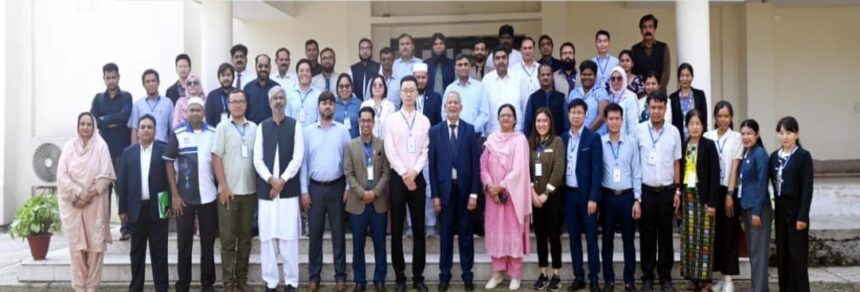
Islamabad, 19 October 2025 — A regional training course on mutation breeding concluded successfully at the Nuclear Institute for Agriculture and Biology (NIAB), a leading research institute under the Pakistan Atomic Energy Commission (PAEC). The course, held from 6 October, was organised under the IAEA technical cooperation project RAS5101 and aimed at improving food quality through advanced mutation breeding techniques.
Thirty participants from 14 IAEA member states including Bangladesh, Cambodia, China, Fiji, Indonesia, Laos, Malaysia, Mongolia, Myanmar, Nepal, the Philippines, Sri Lanka, Thailand and Vietnam attended the course, with Pakistan also represented. Two IAEA experts from China and Bulgaria joined the programme to share technical guidance and best practices.
Professor Dr Muhammad Yousaf Salim, Director General Agriculture and Biotechnology at PAEC, addressed the closing ceremony and congratulated the IAEA, NIAB and participants for the successful training. He highlighted pressing regional challenges such as climate change, food shortages, water scarcity, pollution and emerging pathogens, and presented mutation breeding as a practical tool to develop resilient crops to meet future food and nutritional needs.
Dr Salim noted Pakistan’s active role in global food standards as a member of the Codex Alimentarius Commission and stressed that evolving research priorities and strategies are essential to secure food, medicine and biodiversity for coming decades. He reaffirmed PAEC and Pakistan’s readiness to cooperate with IAEA partner countries on agricultural research and capacity building.
Dr Uzma Maqbool, Director NIAB, described the course as an effective platform for knowledge exchange and said long-standing collaboration with the IAEA is now yielding benefits for the wider region. She emphasised NIAB’s work with the agency to produce healthier, more resistant crop varieties to help eradicate food insecurity.
Dr Ziaul Qamar, Course Director at NIAB, thanked all participants and organisers, noting that the interactive sessions, laboratory demonstrations and field visits had sharpened technical skills and will foster future regional partnerships in mutation breeding research.
Dr Kai Wang, the IAEA expert from China, commended Pakistan’s leadership in regional capacity building and its role in strengthening technical proficiency across neighbouring countries. The training covered laboratory methods, field evaluation and practical applications of mutation breeding for crop improvement and plant nutrition.
NIAB, an IAEA-designated collaborating centre, remains active in applying nuclear techniques to crop improvement, soil management and plant nutrition. This was the third regional training course hosted at NIAB during 2025 under the Government of Pakistan and PAEC, reinforcing Islamabad’s role as a hub for agricultural research and regional cooperation in mutation breeding.