



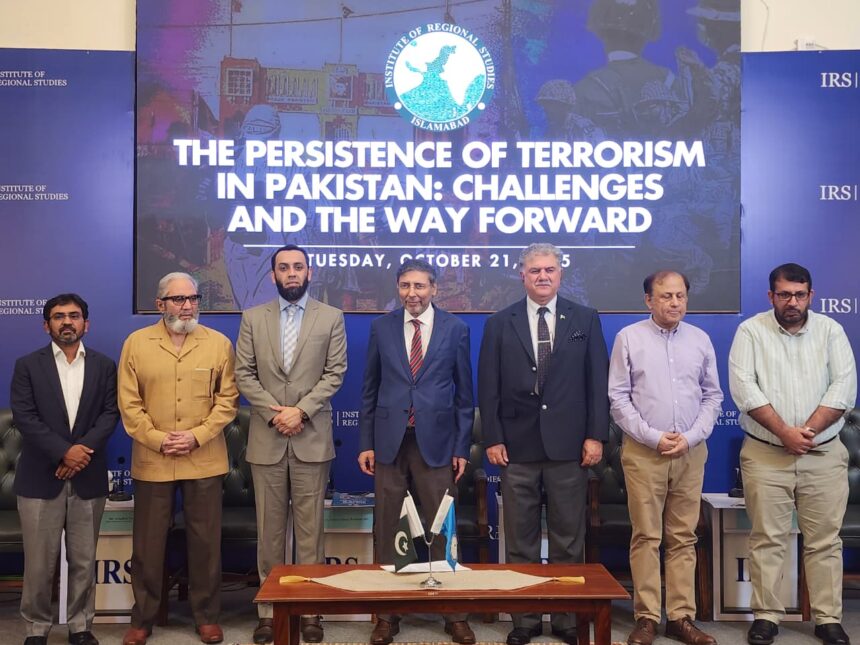
The Institute of Regional Studies in Islamabad convened a high-level seminar titled “The Persistence of Terrorism in Pakistan: Challenges and the Way Forward,” bringing together senior military officials, strategic analysts, policymakers and academics to examine evolving threats and Pakistan’s counterterrorism posture.
Attaullah Tarar, Federal Minister for Information and Broadcasting, reiterated the government’s unwavering commitment to eradicating terrorism in all its forms and praised the armed forces for their sacrifices. He said Pakistan’s contributions to the global fight against terrorism reflect a national resolve to protect peace and progress and urged cohesive, nationwide implementation of the National Action Plan as essential to ensuring lasting peace.
Ambassador Jauhar Saleem, President of the IRS, warned that terrorism remains a serious threat with hundreds of attacks recorded this year and attributed much of the violence to external proxies. He expressed concern over the Taliban’s failure to meet counterterrorism commitments and described Pakistan’s dual approach of active diplomacy alongside kinetic operations. Ambassador Saleem voiced cautious optimism following the Doha ceasefire and ahead of the Istanbul dialogue, while stressing that stability in Afghanistan will depend on whether Kabul chooses peaceful cooperation with Pakistan rather than supporting anti-Pakistan networks.
Lt. Gen. Khalid Rabbani (Retd.) stressed that successful counterinsurgency requires a whole-of-nation approach; security forces cannot shoulder the burden alone. He called for political consensus and societal resilience and highlighted the interdependence of Pakistan and Afghanistan’s security, noting that instability on one side of the border directly affects the other.
Maj. Gen. (Retd.) Inam Ul Haq pointed to a sharp rise in cross-border incidents, reporting 585 Afghan-backed attacks up to October 2025 compared with 521 in 2024 and 306 in 2023. He said that during October 11–15, IEA forces, aided by the TTP and other militants, launched unprovoked attacks along the Pakistan-Afghanistan border, a pattern he described as evidence of active collusion between elements of the Taliban regime and anti-Pakistan networks.
Dr. Muhammad Feyyaz highlighted a gap in academic study of terrorism’s long-term societal and state impacts in Pakistan and urged strengthened links between research institutions and policymakers to produce more informed, policy-relevant analysis that can guide counterterrorism strategy.
Mr. Abdul Basit, Senior Associate Fellow at RSIS Singapore, said regional geopolitics, ideological drivers and governance shortfalls in Afghanistan sustain extremist threats. He recommended revamping Pakistan’s counterterrorism framework to confront emerging threats, noting that non-kinetic responses currently lag and must be strengthened alongside kinetic measures for a balanced and multidimensional strategy.
Speakers across the seminar converged on the need for unified national action, stronger civilian and academic engagement, and coordinated regional diplomacy to reinforce Pakistan’s counterterrorism efforts and secure long-term stability along its borders.