



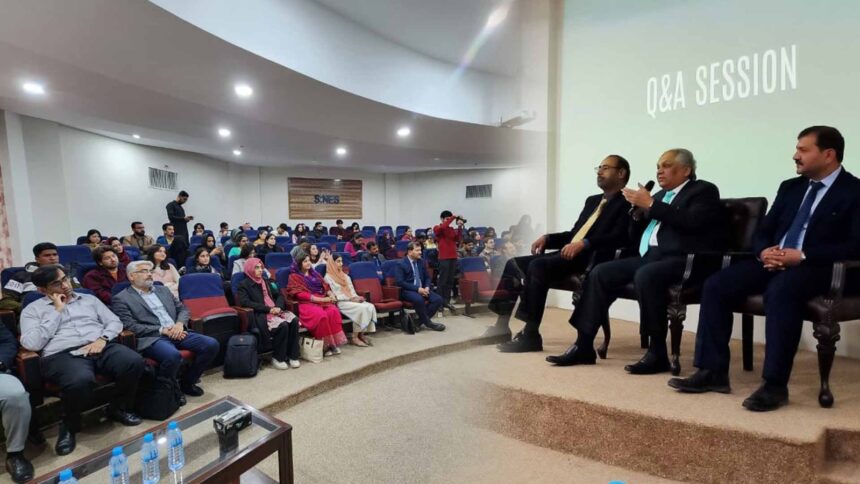
A comprehensive awareness seminar at the Jinnah School of Public Policy, NUST brought Article 19-A and the Right of Access to Information Act, 2017 into focus for a large gathering of students from diverse academic programs. The event, organised with Veritas Associates and Legal Consultants, featured detailed presentations by officials from the Pakistan Information Commission and veteran RTI practitioners.
Advocate Munir Ahmad traced the global evolution of RTI laws and their progression in Pakistan, highlighting landmark case studies and notable orders by the Pakistan Information Commission that have helped citizens obtain public records from government bodies. His remarks underscored how RTI laws empower citizens to seek information that clarifies how decisions are made and public funds are spent.
Shoaib Ahmad Siddiqui, Chief Information Commissioner at the Pakistan Information Commission, spoke about the constitutional inclusion of the right to access information and framed the Act as a tool for participatory and good governance. He urged students to read the Act and to use RTI laws to inspect procurement and expenditure, stressing that transparency strengthens public trust and civic engagement.
Ijaz Hassan Awan, Information Commissioner, briefed attendees on the practical steps for filing information requests and appeals. He explained key provisions including Section 7 on exemptions and Section 16 on sensitive matters, and reiterated that citizens are not required to provide reasons when requesting information. The Commission first assesses the maintainability of appeals before issuing notices to the relevant public body.
Speakers warned that reluctance among officials to share information remains a challenge and outlined enforcement measures: officers who fail to provide information may face penalties of up to 100 days’ salary and continued non-compliance can lead to contempt of court proceedings. Such measures, they said, are critical to making RTI laws effective in practice.
Opening remarks by Mr Hassan Jalil Shah, Principal of the School of Social Sciences and Humanities, welcomed participants and thanked the Pakistan Information Commission and the organisers for their presence. In closing, Uzair Hashmi, Head of Department at JSPP, reflected that faculty and students gained valuable insights into how RTI laws support transparency and accountability in Pakistan.
Students posed questions on the Pakistan Information Commission’s procedures and heard perspectives from both the commissioners and appellants, guided by Advocate Munir Ahmad. The seminar reinforced the role of students as ambassadors of awareness, encouraging them to file information requests, pursue appeals when necessary, and use RTI laws to play an active part in strengthening governance.