



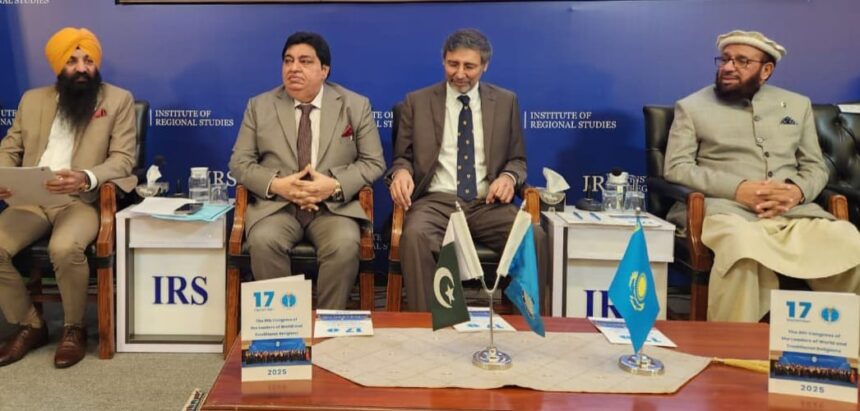
The Institute of Regional Studies convened a seminar in Islamabad on Interfaith Dialogue that examined the outcomes of the 8th Congress of Leaders of World and Traditional Religions and reinforced Pakistan’s role in promoting religious harmony. Organised in partnership with the Embassy of Kazakhstan in Pakistan and the International Islamic University Islamabad, the event brought together religious scholars, government officials, diplomats and academics to discuss concrete steps for interreligious cooperation.
Speakers at the seminar included the Federal Minister for Religious Affairs and Interfaith Harmony Muhammad Sardar Yousaf and State Minister for Religious Affairs and Interfaith Harmony Kesoo Mal Kheal Das, who underscored the importance of sustained engagement between faith communities. Provincial Minister for Minorities Ramesh Singh Arora and representatives from Kazakhstan highlighted bilateral collaboration, while delegates from the Church of Jesus Christ in the United States, including Kelly Johnson, and Prof. Dr. Muhammad Zia-ul-Haq, Director General of the Islamic Research Institute, called for practical initiatives to translate dialogue into everyday practice.
Ambassador Jauhar Saleem, President of the Institute of Regional Studies, said sustained Interfaith Dialogue is essential in an era of polarisation and praised Kazakhstan’s initiative in convening the Congress of Leaders of World and Traditional Religions. He emphasised that open engagement helps build trust, dispel misconceptions and supports peaceful coexistence in Pakistan’s diverse society.
H.E. Yerzhan Kistafin, Ambassador of the Republic of Kazakhstan to Pakistan, reiterated Kazakhstan’s commitment to interreligious cooperation and said the 8th Congress held in Astana on 17–18 September 2025 reaffirmed dialogue as the most viable path to global peace. He noted the historical and cultural ties between the two countries and described the continuing influence of the Spirit of Astana in promoting tolerance and mutual respect.
The seminar reviewed key outcomes of the Astana gathering, where spiritual leaders and experts from over 100 countries focused on peace as humanity’s central value and urged enhanced dialogue amid rising global tensions. Participants in Islamabad discussed how Pakistan can integrate those outcomes into national and community-level initiatives to strengthen religious tolerance.
The audience included diplomats, researchers, journalists and students from leading institutions, reflecting strong civil society interest in advancing Interfaith Dialogue. Organisers said follow-up activities and collaborative projects with Kazakh partners and local institutions will aim to convert the seminar’s recommendations into concrete programmes that promote interreligious understanding across Pakistan.