



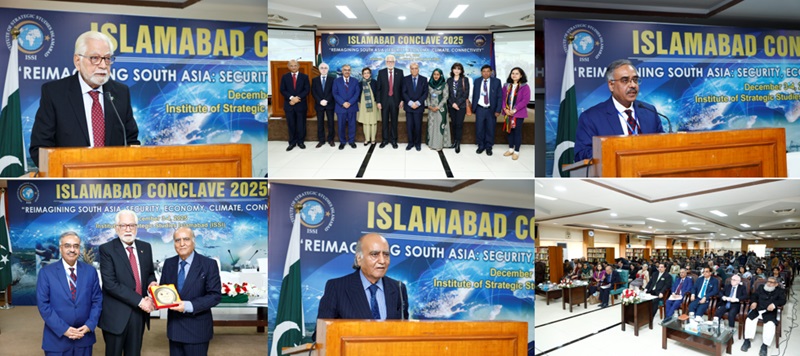
The fifth edition of the Institute of Strategic Studies Islamabad’s annual Islamabad Conclave concluded after two days of wide-ranging deliberations on Reimagining South Asia, with a thematic focus on security, economy, climate and connectivity.
Director General ISSI Ambassador Sohail Mahmood presented the consolidated takeaways from the inaugural session and five working sessions, noting broad consensus that persistent deficits in security, development and regional cooperation continue to constrain the region’s potential. Participants stressed that escalating geopolitical tensions, unresolved disputes, conventional and nuclear build-ups and incidents such as the May 2025 crises underline the fragility of regional stability and the urgent need to move from confrontation to cooperation.
Speakers argued for a shift away from zero-sum approaches toward institutionalised cooperation, stronger connectivity, economic integration and climate resilience as pillars of a reimagined South Asia. The forum highlighted the importance of transcending bloc politics, promoting dialogue, strengthening multilateralism and addressing shared human and environmental challenges through collective strategies.
Deputy Prime Minister and Foreign Minister Senator Mohammad Ishaq Dar urged a fundamental rethink of regional cooperation architecture, advocating pragmatic formats with variable geometry to adapt to new realities. Ambassador Sohail Mahmood also used the occasion to express his gratitude to colleagues and staff as this Conclave marked his final event as Director General before assuming a new responsibility in January 2026.
Chief Guest Ambassador Inam ul Haque delivered a wide-ranging assessment of the evolving global order, observing rapid geopolitical shifts, economic changes and technological transformation. He noted that while the United States remains a preeminent power, China is rising and Russia is resurging, and the ultimate shape of global order remains uncertain. He called for balanced, constructive engagement with all partners while safeguarding national interests, reaffirming Pakistan’s longstanding partnership with China and the continued value of productive ties with Western countries.
On South Asia specifically, Ambassador Inam ul Haque emphasised the need for stronger regional institutions, inclusive growth strategies and human-centred development that prioritises climate resilience, economic diversification and digital capacity building. He underlined that internal consolidation—building a strong economy, addressing population and health challenges, investing in education and improving governance—must remain a national priority.
Ambassador Khalid Mahmood, Chairman Board of Governors ISSI, thanked speakers, panelists and participants and reflected on the transitional nature of the global order. He noted that the Conclave captured complex regional dynamics and offered forward-looking insights on South Asia’s geopolitical and geo-economic trajectory, while commending the ISSI team for organising a substantive dialogue.
The Conclave brought together diplomats, academics, think-tank experts, civil society representatives, policy practitioners, students and media, reaffirming a renewed call for collaborative approaches to regional peace, stability and shared development in South Asia.