



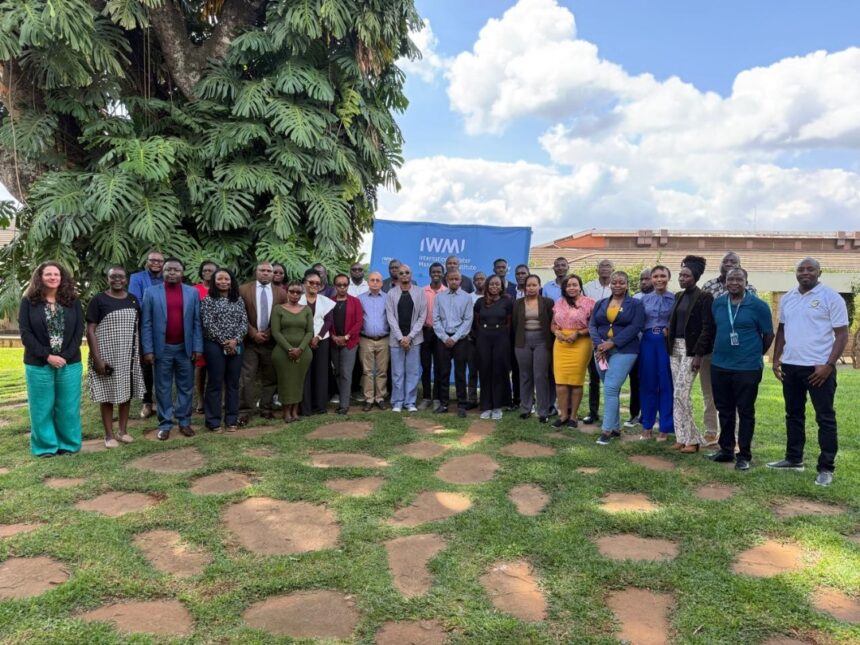
Last week the International Water Management Institute convened policymakers, private-sector actors, researchers and development partners in Nairobi for the WasteWise Stakeholders’ Workshop, a critical step toward data-driven planning in Kenya’s circular bioeconomy and organic waste sector.
The WasteWise Tool, co-developed since 2022 through national and regional consultations, helps municipalities, investors, enterprises and cooperatives map waste streams, assess resource recovery options, test scenarios and make informed investment decisions aligned with circular bioeconomy objectives.
Nairobi City County shared that the city generates between 3,000 and 3,600 tonnes of waste daily with roughly 60 percent organic material, yet only about 40 percent of this waste is collected. Despite open dumping, infrastructure and data gaps, stakeholders identified strong opportunities in composting, recycling, waste-to-energy and Black Soldier Fly valorization.
KEPSA emphasised the role of private-sector innovation, the importance of mapping bioeconomy actors, and the need for regulatory reform and climate-smart business models backed by green financing such as carbon markets and partnerships like P4G.
Enterprises including Protein Master, Ecoloop Solutions and Takataka Nimali showcased practical solutions ranging from BSF-based valorization and on-site composting to digital waste tracking and marketplace platforms that can accelerate circular practices on the ground.
UN-HABITAT pointed to its experience applying the Waste Wise Cities Tool and reinforced that validated waste data is essential for planning, SDG reporting and attracting private investment to scalable waste interventions.
Participants co-identified priority use cases for the WasteWise Tool such as county-level waste mapping, economic zoning for BSF enterprises and the creation of integrated data repositories to inform national planning and investment decisions.
Next steps agreed by stakeholders include building a national digital repository for Kenya’s waste data, strengthening policies and extended producer responsibility pathways for organic waste, increasing capacity for segregation at source, mapping and validating major organic waste streams, streamlining licensing and regulatory processes, and fostering cross-sector partnerships to support pilots and scaling while avoiding duplication.
A sincere thank you was extended to all partners and contributors including Nairobi City County Government, KEPSA, UN-Habitat, Protein Master, Ecoloop Solutions Africa and Takataka Nimali. Special appreciation was given to Tosi Somorin, Solomie Gebrezgabher, Dzifa Agbefu, Josey Kamanda, Inga Jacobs-Mata, James Kinyua, Rahel Mesganaw, Kinyanjui J. Koimbori and Mario Kainga for their coordination, facilitation and technical support throughout the process.
The lessons and tools discussed at the workshop, particularly the WasteWise Tool, offer relevant insights for Pakistani cities seeking to strengthen organic waste management, build reliable waste data systems and attract green investment for circular bioeconomy initiatives.