



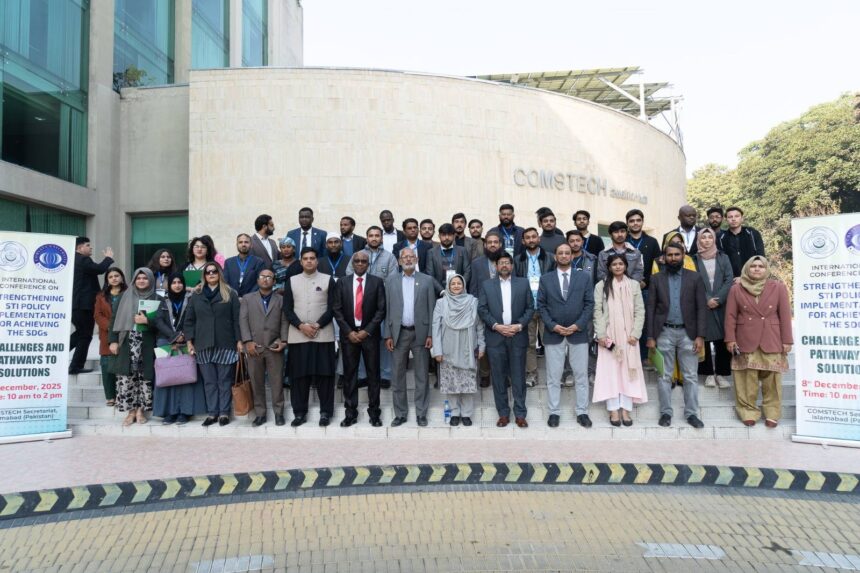
An international conference on strengthening STI policy implementation for achieving the SDGs was held at the COMSTECH Secretariat in Islamabad on December 8, 2025, jointly organised by OIC-COMSTECH and COMSATS University Islamabad. Academics, researchers, policymakers and students from Pakistan and abroad attended in person and online to discuss challenges and practical pathways to solutions for the OIC region.
Prof. Dr. Mudassir Asrar, Adviser Science Policy at OIC-COMSTECH, speaking on behalf of Coordinator General Prof. Dr. M. Iqbal Choudhary, highlighted mounting pressures from climate change, food and energy insecurity and public-health vulnerabilities that make stronger national STI systems imperative. She stressed that a renewed focus on STI policy, coordinated mission-oriented approaches and capacity building are essential to deliver sustainable development outcomes across member states.
Sessions at the conference probed policy gaps and institutional bottlenecks while showcasing regional experiences. Dr Hammad Omer of COMSATS University presented conceptual models to better align STI policies with the SDGs, and Dr Kalsoom Sumra reviewed continental policy frameworks and their applicability to developing regions. Addressing youth challenges, Prof. Dr Muazzam Khattak called for stronger innovation and entrepreneurship ecosystems, while Dr Tariq Mahmood Ali of the Health Services Academy emphasised the central role of evidence-based research in informing policy decisions.
Dr Ismaila Diallo, Regional Advisor for OIC-Africa, outlined recurring constraints that hinder STI policy implementation across several OIC countries, and Dr Javeria Ambreen of COMSATS University highlighted persistent gender disparities and the need for greater inclusion of women within STI institutions. Regional case studies presented by Dr Mitra Aminlou of Iran’s National Research Institute for Science Policy illustrated both successes and failures, and Dr Khaleel Malik from the University of Manchester spoke on university–industry collaboration as a key driver of innovation capacity.
In the concluding session, Dr Diallo presented a draft framework to assist OIC member states in developing and executing effective STI policies. Participants acknowledged that while many countries have national strategies on paper, implementation gaps remain significant and require stronger institutional support, wider stakeholder engagement and practical roadmaps to translate policy into measurable impact within Pakistan and across the OIC region.