



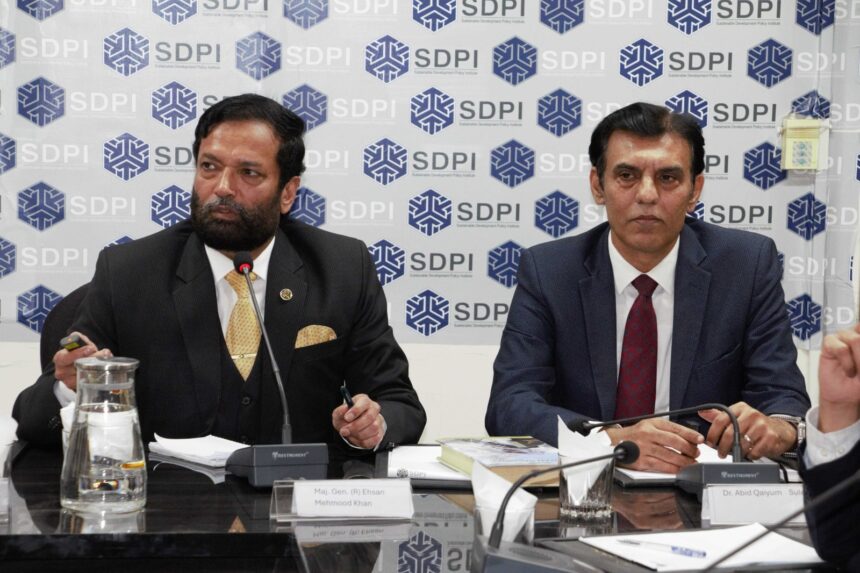
Major-General (R) Ehsan Mehmood Khan, a human security expert and former director-general of the Institute for Strategic Studies, Research & Analysis, told a distinguished lecture at the Sustainable Development Policy Institute that governance and internal systems are central to ensuring human security, effective service delivery and sustainable development in Pakistan.
Tracing the evolution of security from ancient times to the modern state, Maj-Gen (R) Ehsan Mehmood Khan argued that the core purpose of the state remains peace, security and inclusive prosperity. He stressed that prosperity cannot be achieved without integrating security and development objectives and described human security as a critical pillar of that integration.
Drawing on his book Human Security in Pakistan, published in 2013 and used in international courses including at the National Defense University in Washington, he emphasised that national security is not fixed but has evolved through conflict and institutional change. He noted the 1947 US National Security Act as an early model for modern national security architectures, later adapted by many states.
The speaker presented a conceptual model for Pakistan’s Comprehensive National Security that places global security, state security and human security on three interconnected rungs, with state and human security forming the core. He argued that territorial, political, diplomatic, economic, cultural and human dimensions must advance together to create what he called a corridor of prosperity.
In a question-and-answer exchange he underscored that human security cannot be imagined without state security and that a strong state security posture does not necessarily undermine human security. He warned that weak governance and poor resource utilisation can undermine service delivery and public wellbeing, making governance reform essential for sustained gains in human security.
Maj-Gen (R) Ehsan Mehmood Khan pointed to Pakistan’s socio-economic strengths, including more than 10 million overseas Pakistanis, robust remittance inflows and the world’s third-largest freelance community, arguing these assets should be channelled into strengthening internal capacities. He concluded that security enables development and development reinforces security, and that comprehensive security depends on balanced progress across all fronts of national life.