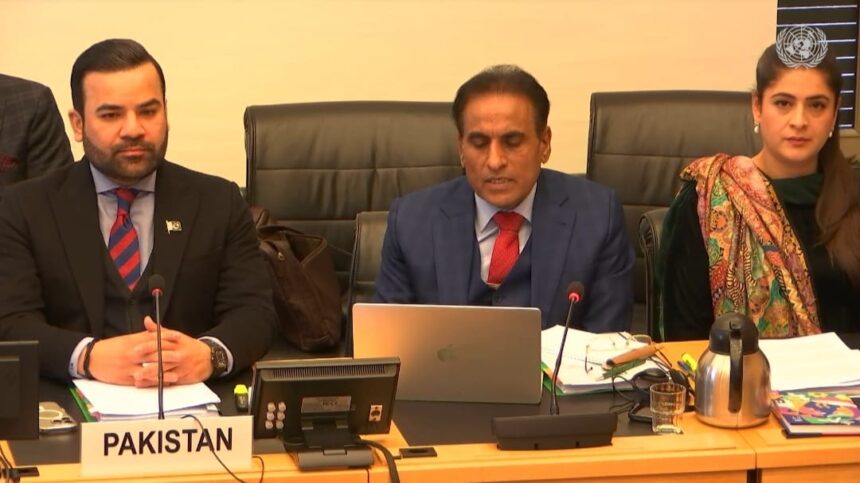
A Pakistani delegation led by Barrister Aqeel Malik presented Pakistan’s progress on child rights before the United Nations Committee on the Rights of the Child in Geneva on 16 January 2026, describing recent legal and policy steps to better protect children nationwide.
The delegation, which included Secretary Abdul Khalique Shaikh, Ms. Sara Ahmed of the Punjab Child Protection and Welfare Bureau and Ambassador Bilal Ahmad, submitted the combined sixth and seventh periodic reports under the CRC along with the initial report under the Optional Protocol on the Sale of Children, Child Prostitution and Child Pornography. Officials told the Committee that, since the 2016 review, Pakistan has pursued extensive legislative, institutional and policy reforms to align with its child rights obligations.
Federal and provincial legislatures have introduced landmark measures, including new provincial bans on child marriage that set the minimum age at 18 for boys and girls, notably the Islamabad Capital Territory Child Marriage Restraint Act, 2025 and the Balochistan Child Marriages Restraint Act, 2025. Parliament has also acted on emerging risks by criminalizing online child sexual abuse and cyberbullying, strengthening trafficking responses, raising minimum marriage ages for religious minorities and introducing statutory maternity and paternity leave and daycare requirements for institutions. The Zainab Alert, Response and Recovery Act continues to play a central role in preventing and responding to abductions and exploitation.
During the interactive dialogue, Barrister Aqeel Malik addressed questions on the Juvenile Justice System Act, 2018, noting that a National Coordination Committee is finalizing implementation rules to ensure uniform application across provinces and effective protection of children in the justice system. These steps reflect a sustained focus on reforming juvenile justice processes as part of Pakistan’s broader child rights agenda.
Policy innovations were highlighted, including the ZARRA mobile application to facilitate reporting and monitoring of child abuse and neglect. Ms. Sara Ahmed emphasized safeguards for vulnerable children and the provinces’ zero-tolerance approach to abuse. To improve access to justice, the Legal Aid and Justice Authority continues to provide free legal assistance for children and other vulnerable groups.
Health and education initiatives were also underscored. The Benazir Nashounuma Programme was cited as a key intervention addressing malnutrition and stunting among children under two by delivering health services, nutrition support and cash assistance. The Government reiterated the 2024 national education emergency to tackle out-of-school children and nutrition deficiencies and described measures to maintain school safety while preserving classroom normalcy.
Pakistan briefed the Committee on its strengthened human rights architecture, noting active coordination among the National Commission for Human Rights, the National Commission on the Rights of the Child and the National Commission on the Status of Women, along with efforts to preserve their independence. The NCHR’s A-status accreditation and the NCRC’s proactive role in child protection were highlighted, as was the National Mechanism for Reporting and Follow-up, which supports evidence-based policymaking and improved federal-provincial coordination. Work is also underway with WHO to develop a strategy to counter violence against children.
Officials pointed to increased fiscal prioritization for children, citing a 25 percent rise in allocations in Punjab and similar increases in Khyber Pakhtunkhwa and Balochistan. While noting substantial progress, the delegation acknowledged persistent challenges such as poverty, regional instability, terrorism and natural hazards that continue to affect the realization of child rights across Pakistan.
The Government reaffirmed its commitment to constructive engagement with the Committee, transparency in implementation and continued reforms to advance the dignity, safety and well-being of all children in Pakistan.