



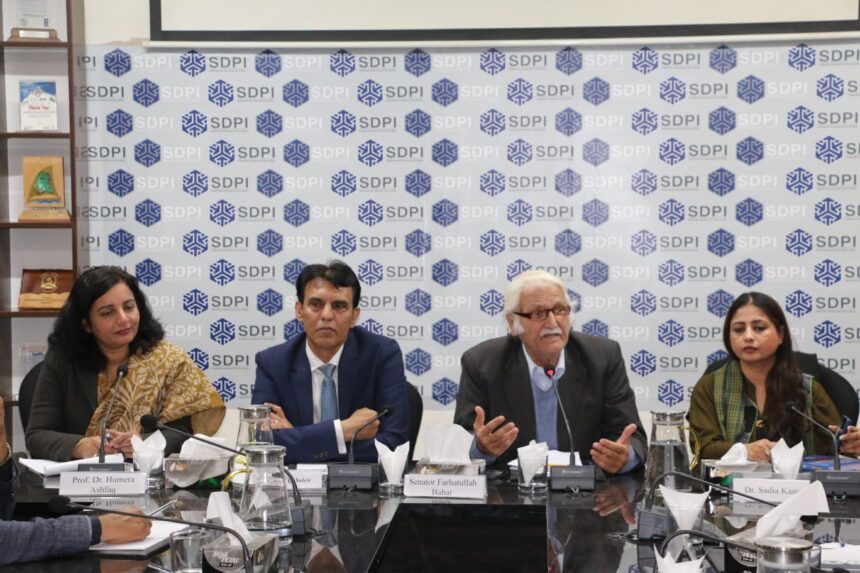
The Sustainable Development Policy Institute brought together scholars, poets and family members to mark the 81st birth anniversary of Ahmed Salim and to press for the digitization of his extensive archives so they remain accessible to researchers and the public.
Farhatullah Babar recalled Ahmed Salim as a national asset who authored more than 150 books and freely shared his knowledge. Mr Babar highlighted Salim’s association with the Communist Party, his detentions, and his critical review of the Pakistan People’s Party 2018 manifesto from a human rights and sustainable development perspective. He underlined Salim’s work on Partition that foregrounded inter-communal solidarity and urged a renewed study of progressive movements in Pakistan.
Dr Abid Qaiyum Suleri described Ahmed Salim’s long association with SDPI and the institute’s decision to establish an Ahmed Salim Research Room in his honour. Dr Suleri reiterated SDPI’s commitment to digitize Salim’s archives so future generations can access his writings on freedom of expression, access to information, social liberty and sustainable development. A special documentary titled Khali Kursi was screened as a tribute to his legacy.
Poet and critic Munir Fiaz spoke of Ahmed Salim’s Punjabi poetry as marked by a rebellious spirit and a command of surrealistic techniques, noting how his diction and form challenged conventional Punjabi literary norms.
Dr Manzoor Veesrio remembered Salim as a regular contributor to the Indus Cultural Festival and a modest, saintly figure whose work spanned writing, journalism, poetry and philosophy. Dr Veesrio said Salim’s critiques of dictatorship and his writings on democracy and human rights remain vital, and that despite his love for Sindh Salim continued to identify strongly as a Punjabi poet.
Dr Shafqat Munir highlighted Ahmed Salim’s research-oriented ethos and his commitment to labour and women’s rights. He recalled Salim’s fieldwork with coal mine workers, his proposals on inclusive education and his efforts to counter extremism through literature, noting that Salim’s work earned him respect across borders.
Panah Baloch reflected on Salim’s deep intellectual and emotional ties with Balochistan, describing how his poetry wove Baloch symbols into Punjabi folk traditions and addressed the region’s historical marginalization while remaining active in the province’s literary circles.
Family recollections added a personal dimension to the event. Amna Rehman described her grandfather Ahmed Salim as an affectionate mentor who passed away while immersed in reading and writing. UK-based writer Nuzhat Abbas paid tribute to Salim’s services to progressive literature, noting his inspiration from Faiz Ahmed Faiz and highlighting that the South Asian Research and Resource Centre founded by Salim houses over 50,000 books and rare collections.
Progressive writer Imdad Akash emphasised the political consciousness in Salim’s literature and remembered his role in forming the Afro-Asian Writers’ Forum and organising its major conference. Other tributes from Mazhar Arif, Dr Sadia Kamal and Prof Saeed described Ahmed Salim as a towering literary figure and an encyclopedia of humanity.
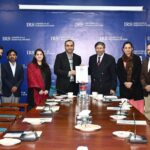
The programme concluded with Dr Humera Ashfaq presenting a souvenir to Dr Abid Qaiyum Suleri and guests joining a ceremonial cake cutting. Participants said the event underlined the importance of preserving Ahmed Salim’s intellectual resistance through digitization and creating sustained spaces for reflection and dialogue on critical social and literary issues in Pakistan.