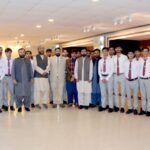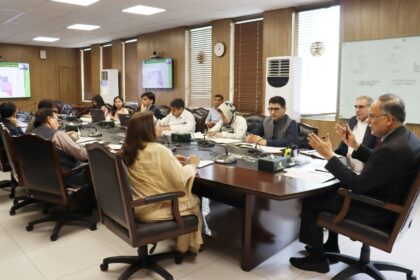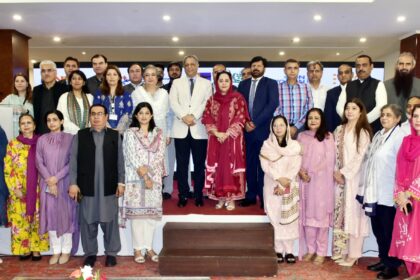



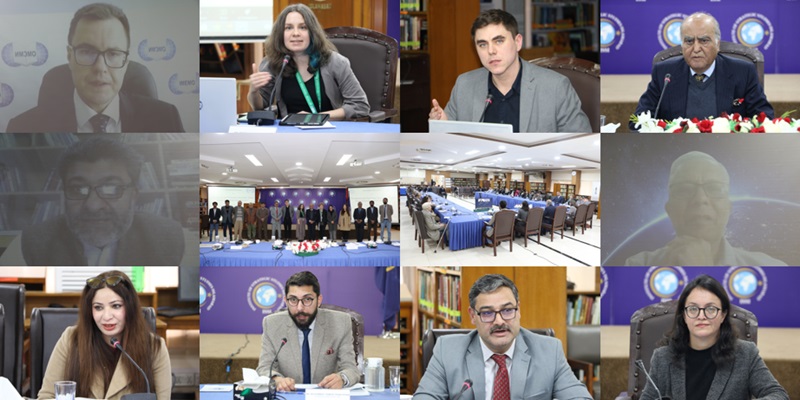
The Centre for Strategic Perspectives at the Institute of Strategic Studies Islamabad hosted a roundtable with scholars from the Institute of World Economy and International Relations (IMEMO) to assess evolving dynamics in European and Eurasian Security and their implications for Pakistan.
Ambassador Khalid Mahmood, Chairman Board of Governors at ISSI, highlighted how shifts in global politics during the 2020s carry direct strategic implications for Pakistan given its geographic position and links to Eurasia. He stressed the need for informed dialogue and reaffirmed ISSI’s commitment to sustained engagement with international research partners such as IMEMO.
Dr. Fedor Voitlovsky, Director of IMEMO, spoke of a long-standing partnership with ISSI and underscored opportunities for enhanced cooperation in infrastructure, energy security, technology and innovation. He explained that Russia views European and Eurasian security as interconnected and argued that differing security concepts, particularly NATO’s expansion, have eroded trust and arms control frameworks.
In her presentation, Dr. Maria Khorolskaya described 2014–2022 as a decisive period in Russia–West relations and traced the roots of the current security crisis to tensions between indivisible security principles and NATO enlargement. She outlined Russia’s security demands and noted renewed European rearmament driven by uncertainty over U.S. commitments.
Dr. Gleb Makarevich framed the evolving regional architecture around initiatives such as the Eurasian Economic Union, links to the Belt and Road Initiative and the Greater Eurasian Partnership, presenting a development-oriented approach to cooperation. He suggested Pakistan can engage constructively in these Eurasian institutional processes and projects of mutual interest.
Pakistani perspectives came from Prof. Dr. Adam Saud, Dr. Saira Nawaz Abbasi, Prof. Tughral Yamin and Prof. Shabbir Khan, who assessed the consequences of European and Eurasian Security trends for South Asia, regional connectivity and shifting geopolitical alignments. Mr. Taimur Khan noted that Pakistan treats Eurasian Security as a complementary and pragmatic framework focused on stability, connectivity and strategic autonomy while remaining attentive to European security developments.
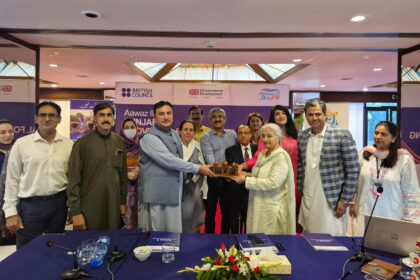
The session, moderated by Dr. Neelum Nigar of ISSI’s Centre for Strategic Perspectives, featured a wide-ranging question-and-answer exchange on NATO–Russia relations, arms control, Eurasian institutional frameworks and the impact of great-power competition on regional stability. The event concluded with Ambassador Mahmood presenting mementoes to the visiting speakers.