On the eve of National Women’s Day, a new PILDAT report finds that women in public service continue to encounter entrenched barriers to leadership across Pakistan despite constitutional guarantees and workplace protection laws. The report, Women in Public Service in Pakistan: Barriers and Recommendations, prepared with support from Interloop Limited, was launched in Lahore on February 11, 2026.
The launch brought together women leaders from politics, the civil service, law, media and civil society for a dialogue on structural and institutional factors shaping leadership outcomes. Mr. Ahmed Bilal Mehboob, President of PILDAT, and Nabila Hakim Ali Khan, Provincial Ombudsman for Protection Against Harassment, joined the session and contributed to discussions on accountability and institutional reform.
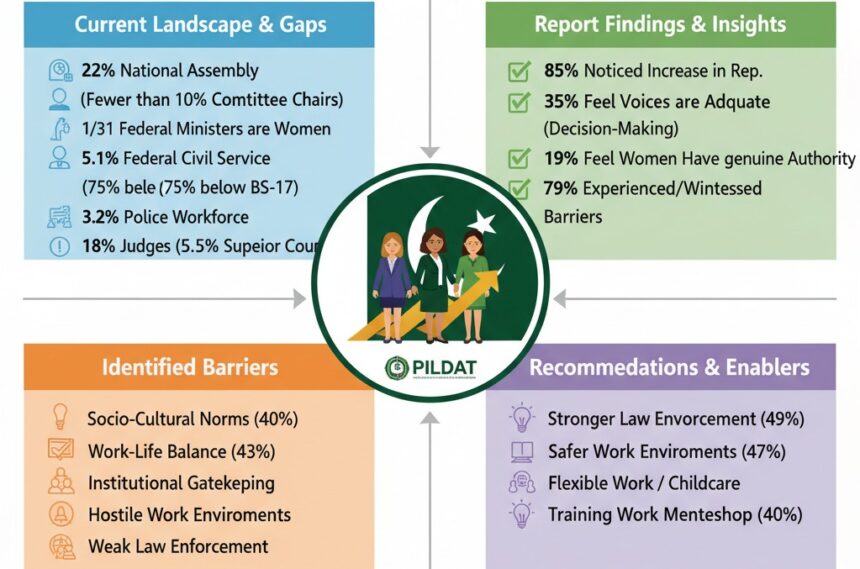
The report highlights a clear gap between numeric representation and actual influence. Women make up about 22% of National Assembly members yet chair fewer than 10% of Standing Committees. Of 31 federal ministers, only one is a woman. In the federal civil service women represent just 5.1% of the workforce, with more than three quarters of these posts below BS-17. Women account for only 3.2% of the police, and although they are around 18% of judges and judicial officers overall, only 5.5% serve as judges in superior courts.
Survey findings presented alongside the report show that while 85% of respondents noticed increased representation over the last decade, only 35% believe women’s voices are adequately represented in decision-making spaces. Just 19% felt women occupy positions of genuine authority, with most describing women’s participation as a mixture of real influence and tokenism. Nearly four in five respondents said they had personally experienced or witnessed barriers to advancement.
Respondents identified multiple overlapping obstacles restricting women’s leadership. Socio-cultural norms and gender roles were seen as a strong barrier by 40%, while work-life balance pressures were cited as a strong barrier by 43%. Participants also pointed to institutional gatekeeping and exclusionary informal networks, unsafe or hostile work environments, and weak implementation of gender equality and anti-harassment policies.
The report records which measures professionals see as effective enablers: 44% singled out flexible work arrangements and childcare support, 41% highlighted training and capacity-building initiatives, and 40% emphasised mentorship and leadership programming. When asked about urgent priorities for the future, 49% urged stronger enforcement of existing laws and policies while 47% called for safer, more inclusive workplaces.
PILDAT’s findings underline the need for cross-sector reforms to translate representation into real authority. Strengthening enforcement mechanisms, expanding flexible work and childcare support, and tackling exclusionary informal networks are central to improving outcomes for women in public service and ensuring that numerical gains become meaningful leadership.