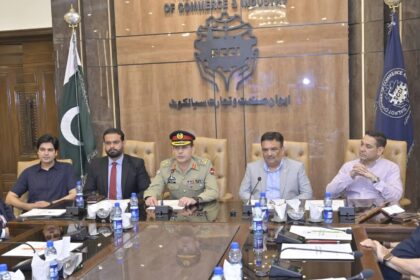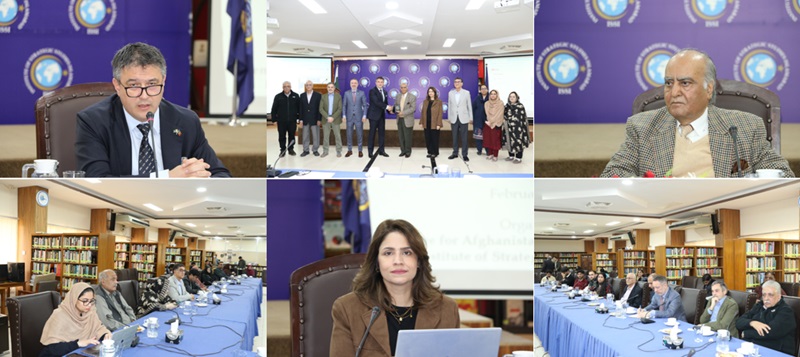
The Institute of Strategic Studies (ISSI) Centre for Afghanistan, Middle East and Africa (CAMEA) hosted a Distinguished Lecture titled Rethinking Europe’s Middle East Policy, featuring Dr. Flavius Caba Maria, president of the Middle East Political and Economic Institute, Romania. Dr. Amina Khan, director of CAMEA, and Ambassador Khalid Mahmood, chairman of the ISSI board, also addressed a diverse audience of diplomats, academics, students and civil society actors.
Dr. Amina Khan outlined three interlinked priorities shaping EU approaches: engagement with the Gulf, the shifting dynamics of the Israel–Palestine conflict amid the Gaza war, and diplomatic management of relations with Iran. She noted how the prolonged Gaza conflict has altered public opinion across Europe and increased pressure on policymakers to factor humanitarian concerns into their Middle East Policy while continuing to prioritise non-proliferation and regional stability vis‑à‑vis Iran.
Dr. Flavius Caba Maria characterised the EU’s Middle East Policy as cautious, legally anchored and internally fragmented, responding to changing geopolitics. On Gaza he pointed to the EU’s reinforcement of existing international frameworks, its welcome of UN Security Council Resolution 2803 and insistence on any Board of Peace operating within a UN-led structure. He reiterated the EU’s commitment to international law and a two‑state solution, expressing concern about developments in the West Bank that undermine viability and recalling long-standing reference points such as pre‑1967 lines, the Oslo Accords and statehood criteria.
Turning to the Gulf, Dr. Flavius highlighted the growing strategic value of EU–GCC cooperation after the October 2024 EU–GCC Summit and within the Joint Action Programme 2022–2027, with trade corridors, technology exchange and sustainable energy forming key pillars for Europe’s diversification agenda. On Iran he described relations as at a historic low following the EU’s designation of the IRGC as a terrorist organisation, a move that narrowed diplomatic channels, complicated prospects for the JCPOA and risked sidelining Europe in wider U.S.–Iran negotiations. He warned that internal EU divisions, dependence on the American security architecture and the diminished mediator role of the E3 since 2018 have constrained European leverage.
Addressing Syria, Dr. Flavius said the EU has recalibrated policy toward selective engagement driven by security and migration concerns, emphasising counterterrorism coordination and substantial financial support for stabilisation and humanitarian relief. Ambassador Khalid Mahmood observed that Europe’s stance reflects an ongoing tension between stated values—human rights and international law—and strategic interests in regional stability, noting EU diplomatic engagement across Gaza, Lebanon and Syria alongside humanitarian assistance.
The discussion underscored how evolving European choices on the Middle East Policy carry implications beyond Europe, including for regional diplomacy and humanitarian advocacy in South Asia. The lecture concluded with a lively question and answer session that engaged practitioners and scholars on the future contours of EU involvement in the region.