



The Girls’ Education Statistics and Trends Report 2023–24, launched in Islamabad, highlights measurable progress in girls education across Pakistan while drawing attention to persistent gaps that require urgent policy action.
The report notes that 96% of schools are housed in permanent buildings, 92% have functional toilet facilities and 82% provide access to clean drinking water. Malnutrition and its impact on stunting and underweight children remain a serious concern even as the primary school completion rate for girls rises from 75% to 89%.
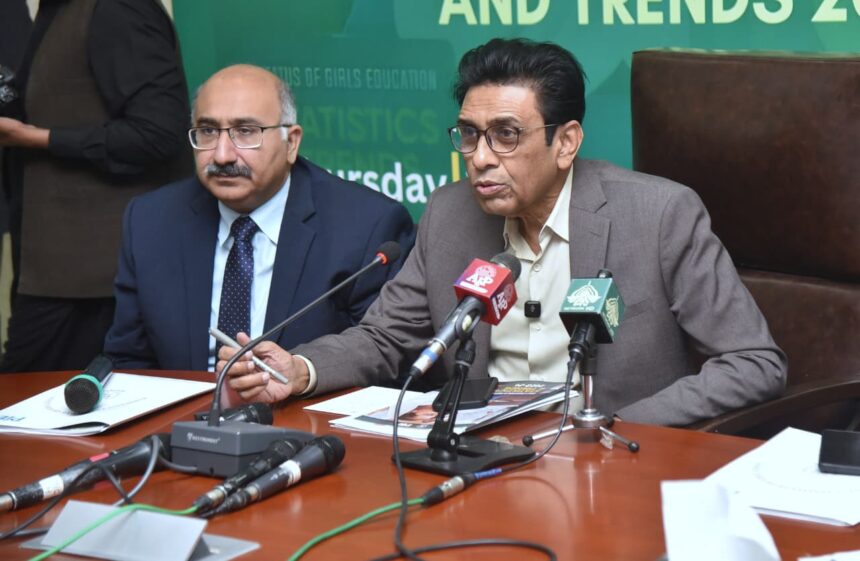
The study was prepared collaboratively by the Pakistan Institute of Education, the Malala Fund, PAGE and the Ministry of Education and was launched at the Pakistan Institute of Education in a ceremony attended by Federal Minister Khalid Maqbool Siddiqui, Minister of State Wajiha Qamar, Federal Parliamentary Secretary Farah Akbar Naz, Senator Fauzia, Director General Dr. Muhammad Shahid Soroya and education experts and partners.
Federal Minister Khalid Maqbool Siddiqui stressed the importance of reliable data for effective policymaking and warned that without accurate statistics problem solving will remain difficult. He said that societal attitudes must change to prevent girls from dropping out, urging families and communities to support girls’ ambitions. “When the state places a degree or a skill in a girl’s hand, it is her right to be allowed to move forward,” he said, adding that Pakistan’s large youth population must be treated as an asset rather than a burden.
Minister of State Wajiha Qamar indicated that an action plan will be developed to translate the report’s findings into reforms. Dr. Muhammad Shahid Soroya pointed to the National Achievement Test 2023 results, noting that girls outperformed boys in English, Urdu/Sindhi and Mathematics and that Grade 8 girls also excelled in Science and Mathematics. He emphasized that compiling such data helps identify systemic gaps and strengthen evidence-based policymaking.
Despite gains, the report highlights significant challenges: the number of schools per 1,000 children has declined under population pressure; only 23% of schools have ramps for students with disabilities and even fewer provide special teaching materials or assistive devices. Just 23% of teachers in girls’ schools have received foundational training and only 19% of schools are equipped with digital devices. The education budget’s share of national spending has fallen from 13% to 11%, with 94% of education funds consumed by salaries, leaving little for development.
The report also warns that 26.2 million children remain out of school nationwide, including 13.4 million girls, and that while women approach parity in higher education enrollment their participation in the labour force is only 24%, representing a substantial loss of human capital.
Experts concluded that Pakistani girls have demonstrated clear talent and capability, but systemic weaknesses continue to obstruct their educational journeys. The report calls for a stronger education budget, modernised teacher training and a nationwide expansion of digital facilities to sustain the gains in girls education and turn potential into lasting social and economic benefit.