



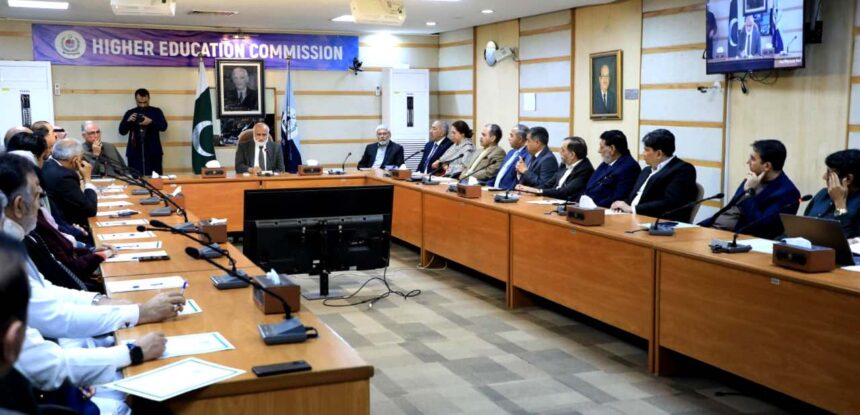
The Higher Education Commission has constituted multiple committees of university heads to develop a Five Year reform roadmap aimed at the holistic development of Pakistan’s higher education sector and an enhanced role for academia in national growth. The decision followed a Vice Chancellors meeting at HEC Islamabad attended by around 40 university leaders from Islamabad, Rawalpindi and adjoining areas and was presided over by Chairman Prof. Dr. Niaz Ahmad Akhtar.
Committee members will deliberate on short-term, medium-term and long-term measures and submit detailed reports to HEC. The workplan emphasises a comprehensive skills-based curriculum review, strengthening institutional autonomy and advancing the Triple Helix model to deepen government‑academia‑industry collaboration. Proposals under consideration include simplifying audit and procurement procedures, introducing dual degree programmes and establishing a standardized student assessment mechanism aligned with international benchmarks.
A central priority is the creation of new accreditation councils for emerging and high-demand fields, specifically Mental Health and Psychology, Artificial Intelligence, Maritime Sciences and Renewable Energy. The committees will also focus on faculty development and a strategic revision of Tenure Track System (TTS) salaries to retain top-tier academics and curb brain drain, alongside measures to boost research funding and output.
Vice Chancellors highlighted institutional governance and quality as pressing challenges and urged confidence-building measures to strengthen government‑industry‑university linkages and the internationalisation of Pakistani universities. A proposal to establish a central repository for students to explore career pathways was discussed, along with the need to secure graduate data to assess employability and ensure graduates are equipped with up-to-date technological skills.
Chairman HEC Dr. Niaz Ahmad Akhtar underlined that Pakistan’s future is closely tied to the performance of its higher education institutions, noting their commendable outcomes despite relatively low per-student public spending. He reminded university leaders of their demanding responsibilities as hubs of knowledge creation and nation building and called for concerted action to raise enrolment ratios and improve the quality of graduates as part of the broader HEC reform roadmap.