




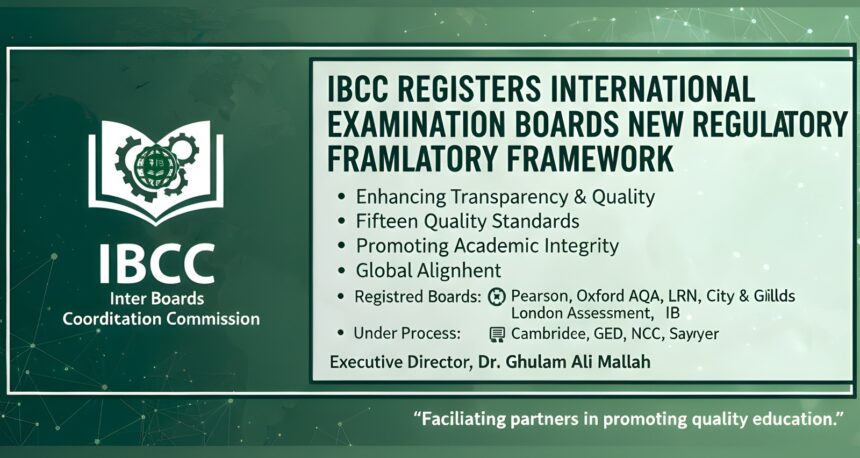
The Inter Boards Coordination Commission has begun the formal registration of international Qualification Awarding Bodies under its new regulatory framework following the mandate of the IBCC Act XIII of 2023. This IBCC registration aims to regulate foreign examination boards operating in Pakistan and to safeguard standards for international qualifications offered within the country.
The regulatory framework requires applicant organisations to meet fifteen (15) quality and governance standards covering institutional governance, assessment integrity, quality assurance mechanisms, regulatory compliance and operational transparency. Applications were scrutinised against these criteria, reviewed through the prescribed evaluation process and considered by the IBCC Regulatory Committee before final decisions were made.
Following the completion of the assessment process, several international awarding bodies have been successfully registered, including Pearson Education Limited, Oxford International AQA Examinations Limited, Learning Resource Network (LRN), City & Guilds of London Institute, London Assessment Board Limited and the International Baccalaureate Organization (IBO). These registrations reflect the IBCC registration process and its focus on transparency and standardisation.
Other prominent organisations have applied and remain under assessment, among them Cambridge International Education, General Educational Development (GED), NCC Education Limited and Sawyer Scholastics & Academy. Their applications will be placed before the Regulatory Committee after the completion of the required reviews, as part of ongoing efforts to broaden regulated international options for students in Pakistan.
Dr Ghulam Ali Mallah, Executive Director IBCC, said the commission is facilitating foreign examination boards to operate as partners in promoting quality education rather than merely as commercial entities. He stressed that the goal of the framework is to ensure international qualifications offered in Pakistan meet global standards while contributing positively to the development of the national education system.
Dr Mallah noted that IBCC is also pursuing recognition discussions with accreditation bodies in the United Kingdom to reduce the need for Pakistani students to undertake an additional foundation year at UK universities. An initial review report has been received and IBCC is preparing its response while compiling the necessary documentation. The commission is simultaneously improving internal processes through the integration of modern technology and examination reforms designed to shift assessment culture away from rote learning toward conceptual and competency based learning, reinforcing the objectives of IBCC registration.