Is Pakistan’s uncontrolled population growth rooted in disincentives in the current National Finance Commission Award?
Madeeha Gohar Qureshi (Research Economist)
Pakistan Institute of Development Economics
As per National Census 2023 estimates, not only population is increasing at high rates of 2.55% nationally in Pakistan but it is urbanisation at high rate of 3.65% without showing any signs of any structural transformation required for high GDP growth end. This is alarming since deeper analysis within Pakistan@2050: Demographic change, future projections, and development opportunities shows that this trend of high urbanization in Pakistan is primarily linked to nature increase of high fertility rates along with low death rates and not due structural shifts related to more modernization and upskilling leading to increased internal rural to urban migration in search of productivity and income gains.
Why it is matter of extreme concerns. One it negates the hypothesis that high urbanization in Pakistan should be considered a sign of development given more people in urban settings means more economic activity. Further with mere growth of 1.1 percent per annum for Pakistan the five major crops namely wheat, rice, sugarcane, maize and cotton for last two decades along with GDP per capital growth rate less than 2 percent as of recent estimates, such a high population growth without any positive structural shifts points vulnerability not just at food security front for Pakistan but at all levels whether it be education, health or any development project in general. With such high population growth, the capacity of state to secure effective public service delivery is very much depleted with miniscule fiscal space per person left. Hence uncontrolled population growth in Pakistan should be considered as among the most pressing developmental issues at hand.
Why has Pakistan failed to control its high population control rate when its neighbouring country India that share its common cultural history has successfully brought it down to 0.89 percent, needs introspection. The fact that Pakistan is witnessing this despite having very high unmet need of contraception among females. Hence desire to control fertility is there, yet it is unmet. There has been a lot of discussion on failures on demand and supply side polices especially post 2000s. However, the political economy aspect of the problem has been a bit ignored. In this context, it is important to realize that one very clear reasons that needs immediate revisiting is the misaligned incentive placed within the ongoing National Finance Commission (NFC) award.
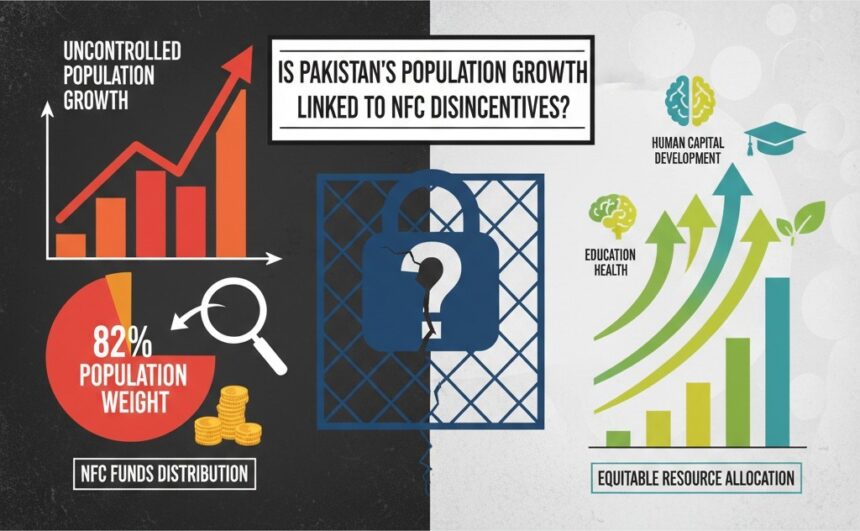
Whereby in ongoing NFC 82 percent weightage in funds distribution formula among provinces has been put on their population sizes implying larger the population count of any province, the larger pie of the tax revenue will be paid to them by the federal government. The real question for thought is that does this not incentivize each province to not control population or raises a possibility of something even more worrying that is of them to perhaps over report their population size for getting more revenues.
This concern become even more real in face of electoral representation being attached further to population count within the constituencies. Further some puzzling results with Pakistan National Census 2023, add to more evidence for tangibility of the impact of these political economy factors aligned with over reporting. As per national Census Baluchistan and Sindh share in population have increased substantially from past censuses which has been explained via increased inter provincial migration. But once demographers test these patterns against the estimates from last Pakistan Demographic Health Survey 2017-18 which was collected just six years before national census 2023, it raises some credibility issues.
As per research of Dr. G. M. Arif, ex-joint Director, Pakistan Institute of Development Economics and an extremely established and renowned demographer, not only Pakistan Demographic Health Survey 2017-18 estimates about internal migration between province does provide support to this effect as emphasized within national census 2023 but high intercensensal population growth rate in between period 2017 and 2023 as well as methodological changes in censuses implementation raises alarm bells.
Even if this above debate of the existing resource distribution formula, which heavily weights population and how it may have disincentivized provinces from implementing effective population control measures to secure larger shares of federal revenue or credibility issues within census it may have created is set aside for a moment, the deeper debates of getting funds from provinces to local governments, where actual developmental projects needs implementation is another set of divide that current NFC is silent on.
Current NFC has taken away powers from centre to manage education and health in Pakistan considering it a provincial issue, being left with issue of debts, defence, and infrastructural investment only, but truth is provinces are neither contributing in raising revenues nor are carrying a debate about provincial finance award to take funds to local levels. Hence not only population size is increasing but investments in health and education have also been compromised. This is unlike other countries where social sector investments are federal domain. For example, in India, where not only within their NFC award the share given to population has been substantially to move towards efficiency based NFC formula but federation has an active role in social sector investments.
To conclude, this demographic challenge necessitates a re-evaluation of the NFC’s population-based distribution criteria within Pakistan to foster a more sustainable and equitable allocation of resources. In this context it is important realize and propagate the policy stance that population management policy is just not about controlling size of population but enriching it with required human capital skills to assure that current high size of youth becomes a positive contributor to growth. Hence incentivizing NFC where it moves beyond populations to find its link it to human development is the key.