



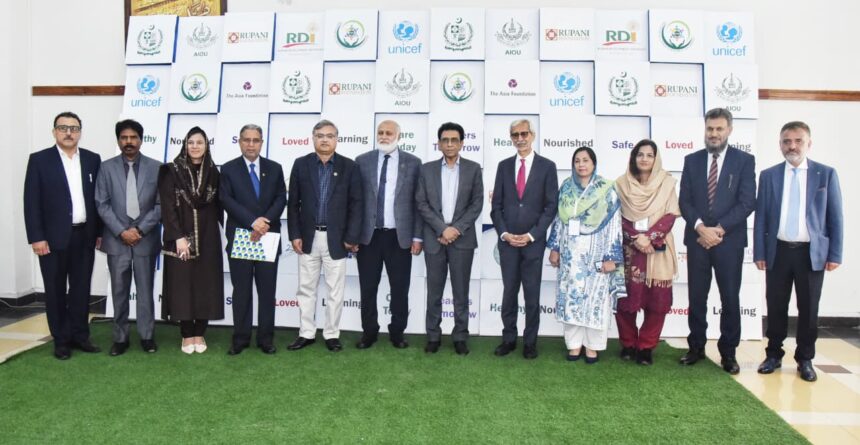
The Minister for Federal Education and Professional Training addressed the 5th International Conference on Early Childhood Development in Islamabad on April 8, 2026, urging concerted investment in early years as a foundation for Pakistan’s long-term prosperity. He framed Early Childhood Development as a strategic national investment rather than a narrow social sector priority, stressing that the period from birth to age eight shapes cognitive development, emotional wellbeing, health and lifelong learning.
Drawing attention to Pakistan’s demographic reality, the Minister noted the large share of young children in the population and outlined persistent challenges including under-five mortality, stunting, learning poverty and high numbers of out-of-school children. He argued these interconnected issues demand a coordinated, multisectoral response that brings together health, nutrition, sanitation, social protection and education.
The Minister highlighted progress since 2017, when collaborative work among national institutions and international partners produced the National Early Childhood Development Policy Framework. He described the framework as a comprehensive roadmap to promote nurturing care across health, nutrition, early learning, child protection and social protection, while urging stronger focus on translating policy into on-the-ground results.
On education-specific measures the Minister reaffirmed the Ministry’s commitment to strengthen Early Childhood Development through expanding access to pre-primary education, improving classroom quality, enhancing teacher training and aligning curricula with international standards while remaining responsive to local needs. He emphasised that improving early learning environments requires both resource allocation and sustained teacher support.
Stressing that education alone cannot resolve all early childhood challenges, the Minister called for a whole-of-government and whole-of-society approach that integrates services and engages communities. He argued that coordinated planning across federal and provincial levels, stronger coordination among ministries, and deeper engagement with development partners and the private sector are essential for creating an enabling environment for children.
The Minister linked ECD to broader economic aims, noting human capital is central to sustainable growth, productivity and innovation. He underlined the role of strong fiscal management to create the fiscal space for increased public investment in priority sectors such as Early Childhood Development and education more broadly, and called for improved monitoring and accountability systems to track progress.
Recognising the role of families, the Minister emphasised parents and caregivers as children’s first teachers and highlighted the need to empower them with knowledge and resources. He urged stakeholders to convert conference dialogue into measurable action and concrete investments to reach every child regardless of geography or socio-economic background.
‘Let us work together to ensure that every child in Pakistan is healthy, well-nourished, protected, and able to learn and thrive,’ he said, calling for renewed partnerships and bold investment in Early Childhood Development to secure Pakistan’s future.