



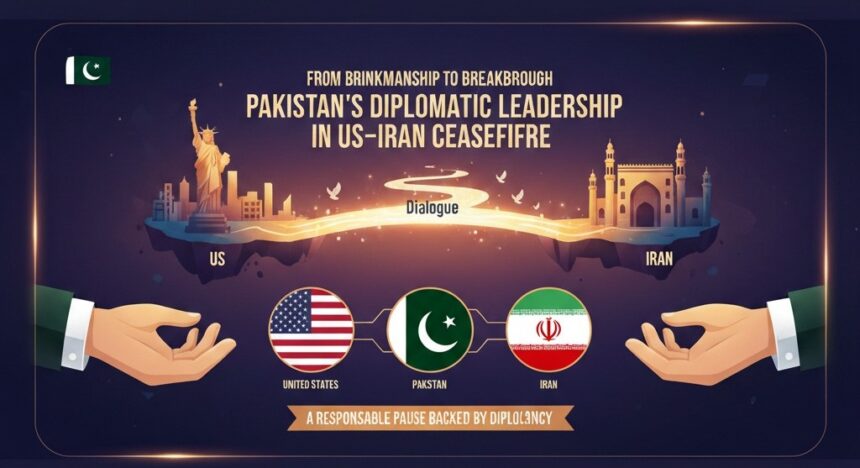
From Brinkmanship to Breakthrough: Pakistan’s Diplomatic Leadership in the US–Iran Ceasefire
By Tasadduq Gilani 
At a time when the Middle East stood perilously close to a wider and potentially devastating conflict, a critical diplomatic breakthrough has offered the world a moment of relief. The recently announced ceasefire between the United States and Iran—while still evolving in scope—has been widely welcomed across global capitals as a timely and responsible step toward de-escalation.
Beyond the immediate headlines, this development carries a deeper and more significant story: the constructive and increasingly influential role played by Pakistan in facilitating dialogue at a moment of extraordinary tension.
A Responsible Pause Backed by Diplomacy
According to reporting and analysis across leading international outlets such as Reuters, Al Jazeera, The New York Times, and The Washington Times, the current understanding between Washington and Tehran represents a structured ceasefire framework—one aimed at halting immediate hostilities while opening space for sustained negotiations.
The United States has signaled satisfaction in achieving short-term strategic stability, while Iran has indicated readiness to pursue a broader, more durable peace—subject to continued engagement and mutual assurances. This convergence, even if partial, reflects a shared recognition of the costs of escalation and the necessity of diplomatic .
Pakistan’s Pivotal Role in De-escalation
In this delicate environment, Pakistan’s role has stood out as both timely and effective. Through calibrated diplomacy and sustained engagement, Islamabad is understood to have facilitated critical communication channels that helped bridge positions at a crucial juncture.
This effort was led at the highest levels of the state:
• Prime Minister Shehbaz Sharif provided strategic direction, maintaining consistent outreach with key stakeholders and reinforcing Pakistan’s commitment to peace and stability.
• Under the stewardship of Field Marshal Syed Asim Munir, Pakistan’s security and diplomatic institutions worked in close coordination to support backchannel engagement and confidence-building measures.
• Deputy Prime Minister and Foreign Minister Ishaq Dar played an active diplomatic role, engaging with regional and global counterparts to sustain momentum toward de-escalation.
Together, this leadership triad demonstrated a cohesive national approach, combining political vision, strategic clarity, and diplomatic agility.
Global Recognition and Positive Reception
Importantly, Pakistan’s efforts have not gone unnoticed. International responses—reflected in diplomatic statements and media commentary—indicate a broad welcome for the ceasefire and the processes that enabled it.
World leaders have emphasized the importance of dialogue over confrontation, and the role of responsible intermediaries in preventing conflict escalation. Within this context, Pakistan’s contribution is increasingly viewed as constructive, credible, and solution-oriented.
This recognition reinforces Pakistan’s image as a country capable of engaging meaningfully in complex international challenges, particularly within the Muslim world and the broader Global South.
Regional Complexity, Managed with Prudence
While Israel has indicated acceptance of the ceasefire in relation to the US–Iran dynamic, it has also clarified that the arrangement does not extend to Lebanon. This highlights the multi-layered nature of regional security challenges, where parallel dynamics continue to evolve.
Nevertheless, the de-escalation between Washington and Tehran represents a significant stabilizing factor, reducing immediate risks and creating diplomatic space for addressing other areas of concern.
Economic Stabilization and Global Relief
The economic implications of the ceasefire have been immediate and encouraging. With tensions easing:
• Global energy markets have shown signs of stabilization
• Fears of disruption in critical maritime routes, particularly the Strait of Hormuz, have receded
• Investor confidence has improved, offering relief to economies sensitive to geopolitical shocks
These developments underscore how effective diplomacy directly contributes to global economic security.
A Defining Moment for Pakistan’s Global Role
For Pakistan, this episode represents more than a diplomatic success—it marks a defining moment in its international engagement.
By contributing to a peaceful outcome at a critical juncture, Pakistan has:
• Reinforced its credentials as a responsible and proactive diplomatic actor
• Demonstrated its ability to build bridges in polarized environments
• Positioned itself as a credible partner in future conflict-resolution efforts
If sustained, this trajectory could elevate Pakistan’s standing in international forums and expand its influence in shaping regional stability.
Conclusion: Diplomacy That Delivered
The US–Iran ceasefire is, above all, a testament to the enduring power of diplomacy. It reflects what can be achieved when nations choose engagement over escalation—and when capable intermediaries help guide that process.
Pakistan’s role in this outcome stands as a source of national pride and international relevance. Through coordinated leadership and principled diplomacy, it has contributed to pulling the region back from the brink.
The path ahead will require persistence, patience, and continued dialogue. But for now, the world has stepped back from the edge—and Pakistan has helped make that possible.