



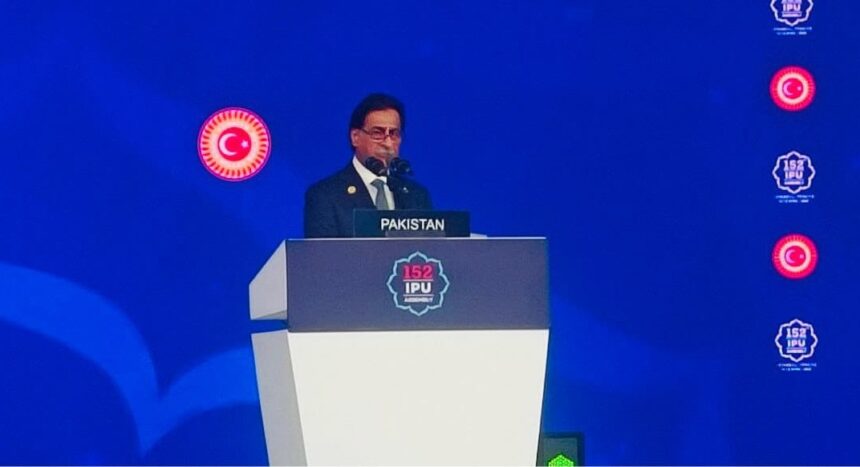
The Speaker of the National Assembly addressed the 152nd Assembly of the Inter-Parliamentary Union in Istanbul and thanked the Grand National Assembly of Türkiye for its hospitality while speaking on the theme “Nurturing hope, securing peace and ensuring justice for future generations.” He described the moment as a critical test for parliamentarians and emphasised that parliamentary diplomacy is essential for rebuilding trust and preventing conflicts.
Sardar Ayaz Sadiq warned that the international system is at an inflection point amid unresolved wars, protracted disputes and emerging crises that cause human suffering and displacement. He urged adherence to the core principles of the United Nations Charter, arguing that durable peace is achieved through dialogue, mutual respect and inclusive diplomacy rather than power projection. The Speaker called for fuller and consistent use of UN mechanisms for peaceful settlement of disputes and highlighted the role parliamentary diplomacy can play in that process.
Addressing regional tensions, the Speaker said the denial of the right to self-determination of the people of Indian Illegally Occupied Jammu and Kashmir remains a fundamental cause of instability in South Asia. He reiterated that Jammu and Kashmir is an internationally recognised disputed territory whose final status should be determined in line with relevant UN Security Council resolutions and the aspirations of the Kashmiri people, and he urged reversal of unilateral measures taken since 5 August 2019.
On water security, the Speaker criticised India’s decision to keep the Indus Waters Treaty in abeyance, calling it irresponsible and contrary to international law and interstate norms. He warned that the weaponisation of water threatens regional stability and underlined that Pakistan reserves all rights to safeguard its due share under the Treaty.
Turning to Palestine, the Speaker described the ongoing occupation, dispossession and violence faced by Palestinians, noting that over the past two years more than 71,000 Palestinians, mostly women and children, have been killed with severe impacts in Gaza as well as rising violence in the West Bank and East Jerusalem. He highlighted recent diplomatic pathways including outcomes of the UN High-Level Conference and the UN General Assembly’s New York Declaration, and reiterated Pakistan’s support for a time-bound political process based on UN resolutions leading to an independent Palestinian state on pre-1967 borders with Al-Quds Al-Sharif as its capital.
The Speaker also welcomed positive responses to Prime Minister Mian Muhammad Shehbaz Sharif’s call for an immediate ceasefire and described the Islamabad talks of 11–12 April, attended by representatives including the Islamic Republic of Iran and the United States, as a historic breakthrough facilitated by Pakistan. He urged all parties to sustain the ceasefire and continue constructive dialogue to secure regional peace and prosperity.
On Afghanistan, he expressed concern about the deteriorating security situation and warned that the country continues to harbour terrorist groups that endanger regional stability. Reiterating Pakistan’s priority for dialogue, he made clear that Pakistan will take necessary defensive measures to protect its citizens, territory and sovereignty.
Highlighting climate challenges, the Speaker noted Pakistan’s acute vulnerability and outlined national initiatives such as the Recharge Pakistan Project for ecosystem-based flood management, the National Carbon Market Policy and climate-sensitive budgeting as steps toward resilience and a green transition. He closed by reaffirming Pakistan’s commitment to work with IPU member parliaments to translate commitments into concrete actions that promote hope, secure peace and ensure justice for future generations, underscoring the central role of parliamentary diplomacy in that effort.