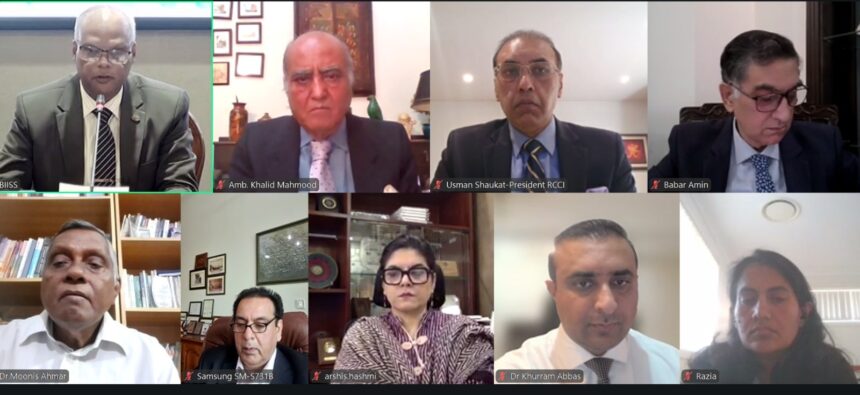
The India Study Centre at the Institute of Strategic Studies, Islamabad, together with the Bangladesh International Institute of Strategic Studies, convened an international webinar to examine Pakistan Bangladesh Dialogue and identify pragmatic pathways for constructive engagement amid shifting regional dynamics.
The session was jointly chaired by Ambassador Khalid Mahmood and Major General (Retd) A. S. M. Ridwanur Rahman, and drew participation from former diplomats, academics, business leaders and research scholars. Speakers included Ambassador Babar Amin, Prof. Dr. Moonis Ahmar, Prof. Dr. Arshi Saleem Hashmi, Dr. Usman Shaukat, Dr. Mahfuz Kabir, Dr. Khurram Abbas, Dr. Sufia Khanom, Mr. Raja Amir Iqbal and Dr. Razia Sultana, who assessed diplomatic, economic and strategic dimensions of the relationship.
In his welcome address, Ambassador Khalid Mahmood underscored the growing momentum in Pakistan Bangladesh relations and highlighted opportunities for economic collaboration, stronger institutional linkages and expanded people to people contacts. He stressed the shared interest of both countries in addressing regional and global challenges such as climate change, food security and sustainable development, and proposed renewed emphasis on SAARC as a platform for regional integration.
Major General Ridwanur Rahman called for constructive engagement that bridges gaps in mutual understanding and offers actionable recommendations for policymakers. He noted persistent political challenges across South Asia and argued that a forward looking Pakistan Bangladesh Dialogue should identify realistic areas of cooperation while treating sensitive issues with due diligence.
Speakers from the business and trade community analysed economic cooperation and flagged persistent impediments despite positive political signals. They noted a leadership commitment to raise bilateral trade to USD 3 billion from roughly USD 1 billion within three years, but warned that mobility constraints, strict trade regulations, outdated payment channels and the lack of a bilateral FTA or PTA have left potential largely untapped. Panelists recommended easing visa restrictions, creating joint special economic zones, facilitating digital trade, diversifying export baskets and better use of multilateral frameworks such as SAFTA and the D-8 to expand B2B ties and move beyond traditional commodity trade.
On regional geopolitics, Ambassador Babar Amin and Dr. Razia Sultana emphasised the importance of regional integration and a shared commitment to reviving SAARC. Prof. Dr. Arshi Saleem Hashmi mapped the shifting strategic landscape and highlighted maritime cooperation as a promising area, proposing a structured tripartite framework that includes Pakistan, Bangladesh and China to broaden partnership options while preserving strategic autonomy for smaller states.
Dr. Moonis Ahmar offered concrete measures to enhance people to people contacts such as academic exchanges, on arrival visas, opening new consulates, maritime transport arrangements and direct air links. Dr. Sufia Khanom examined climate vulnerabilities and national strategies, urging collaborative plans of action between Pakistan and Bangladesh to bolster resilience and climate adaptation efforts.
The webinar closed on a hopeful note with both co-chairs thanking participants and underscoring that sustained Pakistan Bangladesh Dialogue, backed by practical economic and institutional measures, can strengthen bilateral ties and contribute to regional stability and prosperity.