



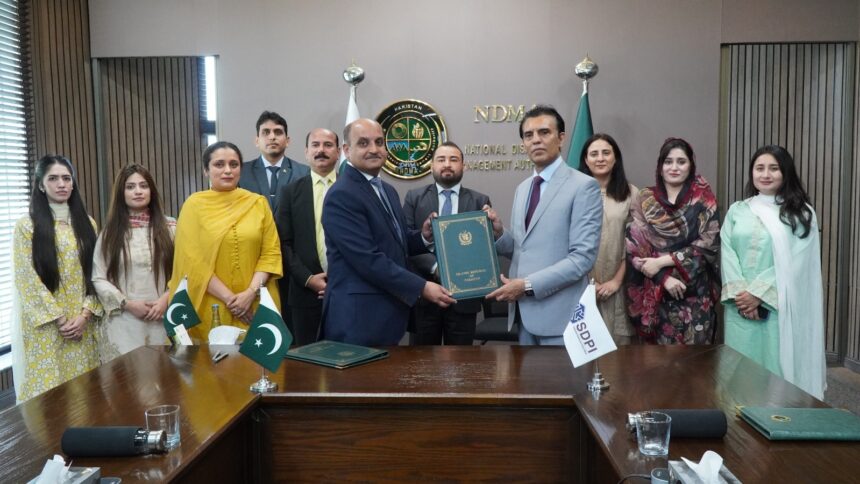
A Letter of Agreement was signed between the Sustainable Development Policy Institute and the National Institute of Disaster Management to advance joint research on disaster risk reduction, climate disaster prediction models and anticipatory actions aimed at strengthening national disaster management capacity.
The signing ceremony took place at the National Disaster Management Authority headquarters in Islamabad with SDPI Executive Director Dr Abid Qaiyum Suleri and NIDM Executive Director Air Commodore (retd) Tanveer Piracha signing the agreement on behalf of their institutions.
Lt-Gen Inam Haider Malik, Chairman of the National Disaster Management Authority, said the intensity and exposure of disasters are increasing each year and highlighted NDMA efforts to introduce innovative disaster risk reduction interventions at the grassroots level. He noted ongoing collaborations with global think tanks and international organisations to build synergised resilience and to integrate more technology for practical solutions.
Mr Malik also described recent technical innovations including the National Emergencies Operation Center and the Pakistan Disaster Lens 2026 and Global Disaster Lens 2026 initiatives, which provide proactive disaster projection models and regional risk forecasts with improving accuracy.
Dr Suleri described the National Emergencies Operation Center as a rich repository of data and evidence that can guide policymakers at federal and provincial levels. He underscored that tackling the growing scale of disasters requires multi-stakeholder action beyond a single government and proposed faculty exchanges with NIDM, offering SDPI faculty and alumni as visiting instructors to bolster capacity and expertise.
Dr Suleri further emphasised the importance of internal resource mobilisation, arguing that reliance on donor funding alone is insufficient. He urged provincial and federal governments to allocate dedicated resources in annual development plans and the public sector development programme to better manage the rising frequency and scale of disasters.
Air Commodore (retd) Tanveer Piracha called the agreement a milestone that will evolve into an enduring knowledge partnership prioritising trigger-based anticipatory actions. He warned that kinetic conflicts and shrinking donor funding demand out-of-the-box collaborative models between institutions such as NDMA and SDPI to sustain disaster resilience work.
Under the LoA, the two institutions will cooperate on joint research and development initiatives focused on climate modelling and disaster risk reduction, co-publish policy briefs and training materials, and organise workshops, conferences and simulation exercises. The partnership will also include capacity-building programmes, internships and professional exchanges to bridge technical knowledge gaps and scale up anticipatory action capabilities across Pakistan.
The agreement is positioned to strengthen institutional collaboration and to promote innovation, resilience and proactive strategies for both natural and human-induced disasters, with climate modelling at the core of efforts to anticipate and reduce future risks.