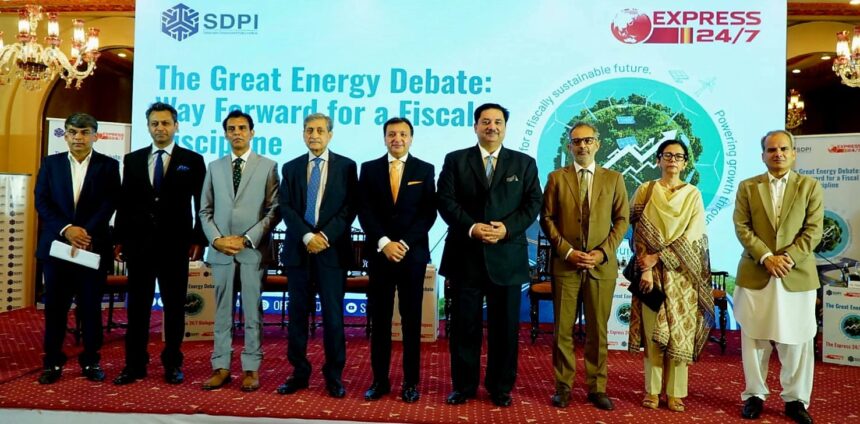
Parliamentarians and energy experts warned at a Sustainable Development Policy Institute debate on 20 May 2026 that rising geopolitical tensions, including disruptions around the Strait of Hormuz, have exposed Pakistan to external shocks and made energy security an urgent national priority.
Ali Pervaiz Malik, Federal Minister for Petroleum, said Pakistan has maintained seamless fuel supplies despite unprecedented global pressures and crude price volatility, and that the government managed the situation without adding a single rupee to circular debt in the oil supply chain. He highlighted a Turkish Petroleum partnership for new exploration and said Pakistan needs large-scale investment, estimated at $200 billion to $300 billion, to expand renewable infrastructure while pursuing a practical transition that balances conventional fuels with renewables.
Bilal Azhar Kayani, Minister of State for Finance, said diversification and indigenization of the energy supply chain through hydropower and solar projects are government priorities. He noted ongoing refinery upgrades to deliver Euro-5 compliant fuel and said electric vehicles will gain traction as they become economically viable for consumers.
Dr Abid Qaiyum Suleri of SDPI underlined that the dialogue comes as the federal budget is being prepared under an IMF programme and regional uncertainty. He praised the absence of fuel rationing so far and urged a shift from blanket subsidies to targeted support through programmes like BISP. Dr Suleri also called for a reassessment of the national solar rollout, stronger grid connectivity and a long-term energy mix to safeguard energy security.
Dr Nafeesa Shah warned that almost 70 percent of Pakistans oil imports pass through the Strait of Hormuz, underscoring the countrys vulnerability. She criticised weak governance, irrational agreements and the lack of strategic oil and gas reserves, and urged an energy paradigm focused on sovereignty, local resources and equitable energy federalism that includes provincial participation in planning.
Panelists pressed for immediate reforms to restore investor confidence and reduce fiscal pressures. Adil Khattak, CEO of Attock Refinery, called for accelerated refinery modernisation and large investments to boost local refining capacity, along with unified ministry leadership. Dr Ali Salman of PRIME argued for deregulation and consumer-friendly pricing. Economists emphasised integrated energy planning, a single coordinated regulator, greater use of rail to cut fuel demand, and the urgent need for battery and storage solutions to complement renewable deployment.
Former ministers and senior commentators warned that governance and cabinet systems must be updated to meet modern energy challenges. Suggestions ranged from technology-driven governance reforms and supply chain diversification to renegotiating strategic arrangements such as the Pak-Iran gas pipeline for geopolitical and economic benefits. Journalists and analysts highlighted how circular debt and policy inconsistency have amplified energy insecurity and called for broader national consensus rather than partisan polarisation.
Chairman of the National Assembly Standing Committee on Finance Syed Naveed Qamar said Pakistan has policy options but lacks fiscal space to absorb shocks, and urged governance reforms, development of indigenous fuel resources and a clear roadmap for local energy mobilisation in the upcoming budget to protect energy security and support vulnerable households.