



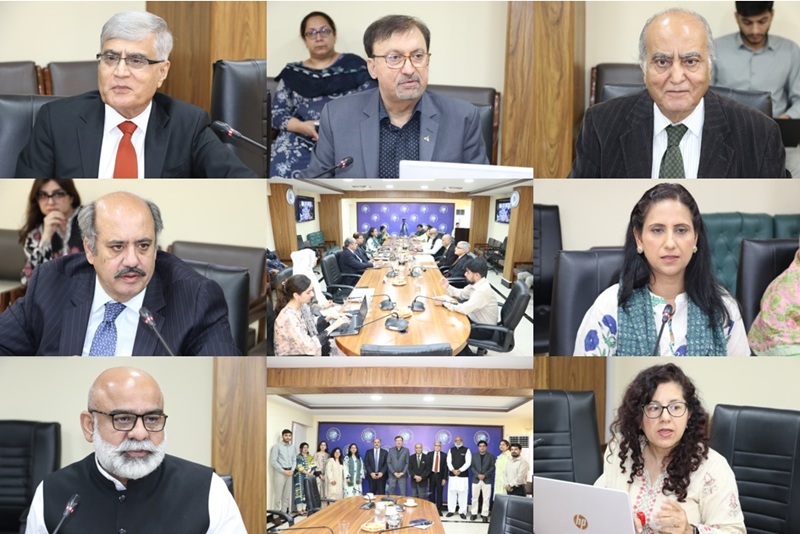
The Arms Control and Disarmament Centre at the Institute of Strategic Studies Islamabad hosted an in-house meeting to mark Youm-e-Takbeer, focusing on strategic stability, emerging threats and the role of diplomacy in South Asia. The session brought together academics, former military officials and policy experts to assess evolving challenges to Pakistan’s security and deterrence.
Ambassador Khalid Mahmood, Chairman Board of Governors at ISSI, underscored that Pakistan’s nuclear capability was adopted reluctantly as a response to regional security imperatives and the need to restore balance after India’s tests. He argued that international appreciation of Pakistan’s security compulsions has improved and reiterated that Pakistan’s deterrence has remained resilient despite repeated attempts to test it. He urged that Youm-e-Takbeer be observed as a significant national milestone.
Malik Qasim Mustafa, Director of ACDC, said May 28 marks a defining day in Pakistan’s history and warned that deterrence faces new pressures from Emerging and Disruptive Technologies. He called for modernization of nuclear posture to ensure deterrence remains credible, effective and responsive to rapidly changing threats and operational environments.
Dr. Rizwana Abbasi highlighted how strategic stability in South Asia is under strain from India’s shifting military posture and new technologies. She noted the legacy of the Cold Start concept and India’s military modernization aimed at limited warfighting options. Dr. Rizwana pointed to unilateral moves on Jammu and Kashmir and the suspension of effective cooperation on the Indus Water Treaty as factors that have compounded regional tensions while precision weapons, drones, surveillance advances and automated systems complicate escalation dynamics.
Air Commodore (Retd.) Khalid Banuri described the convergence of Artificial Intelligence, hypersonic missiles and space systems as a dangerous triangle of escalation that shortens decision timelines and increases crisis risk. He stressed the importance of keeping humans in the decision loop, extending arms control thinking to new domains and strengthening crisis communication. Maj. Gen. Ausaf Ali (Retd.) added that nuclear capability is one element of national power and that modern escalation can involve cyber, space, electromagnetic and quantum domains alongside conventional and strategic forces.
Dr. Zafar Nawaz Jaspal emphasised that sustained diplomatic engagement is indispensable for preserving strategic stability. He noted Pakistan’s active diplomatic efforts in regional crises and urged renewed India-Pakistan dialogue to revive confidence-building and arms control measures. He warned that emerging alignments such as I2U2 and QUAD and a shift toward escalation dominance in Indian doctrine must be factored into Pakistan’s strategic calculations. In the absence of meaningful diplomacy, he said Pakistan must maintain a robust security posture to safeguard national interests.
The discussion closed with an interactive question and answer session among participants and guests, followed by a group photograph to mark the event. The exchange reinforced the centrality of strategic stability and diplomacy as Pakistan navigates emerging technological and regional challenges.