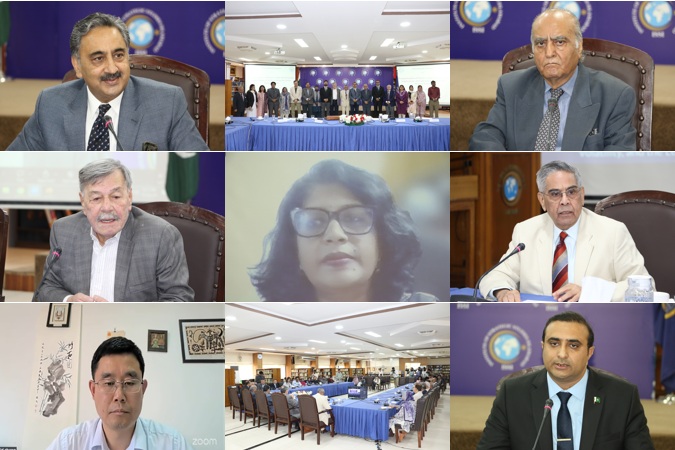
The India Study Centre at the Institute of Strategic Studies Islamabad hosted an international seminar on 10 June 2026 to examine the legal and strategic implications of what speakers described as the weaponisation of water and the erosion of the Indus Waters Treaty.
Ahmer Bilal Soofi, former minister of law, underlined Article 12(4) of the Indus Waters Treaty, saying the agreement can only be modified by mutual consent and cannot be unilaterally abrogated or legally suspended. He recalled statements by India’s leadership since 2014 and criticised the decision to hold the treaty in abeyance, arguing the move appeared premeditated and heightened risks for lower riparian states such as Bangladesh. He also warned that broader political ideologies in the region risk compounding water insecurity.
Ambassador Khalid Mahmood, chairman of the ISSI board, warned that South Asia is already among the most water stressed regions and said water should serve as a bridge for cooperation rather than a tool of confrontation. He stressed that the Indus Waters Treaty is a binding international agreement with no legal provision for unilateral suspension and urged India to restore full implementation while reaffirming Pakistan’s commitment to protecting its treaty rights through lawful and institutional channels.
Dr Khurram Abbas, director of the India Study Centre, noted that prior to April 2025 the Indus Waters Treaty was widely regarded as a durable model of transboundary water governance. He said recent developments, including India placing the treaty in abeyance, have raised serious concerns about regional stability and international law, and pointed to accelerated Indian investment of over 41,000 crore rupees in hydropower projects since the abeyance decision.
Dr Sofia Khanom of the Bangladesh Institute of International and Strategic Studies described Bangladesh as a water stressed country outside the monsoon season, facing climate-driven sea level rise and salinity intrusion that threaten nearly a fifth of the country by midcentury. She highlighted widespread lack of access to safe water, groundwater depletion from irrigation, and growing global competition for freshwater, calling for institution-based water diplomacy while noting reluctance among some Global South actors to invite external mediation.
Ambassador Shafqat Kakakhel recalled the nine years of negotiation that produced the Indus Waters Treaty and pointed to Article 9 as a clear path for dispute settlement. He argued that protecting the treaty is not only Pakistan’s interest but also critical for all lower riparian nations whose rights depend on predictable river flows and robust institutional guarantees.
Dr Zhang Jiadong of Fudan University reviewed the treaty’s history, noting the post-partition river cutoffs, World Bank mediation between 1954 and 1960, and the treaty’s longstanding resilience through conflict. He warned that the 2025 declaration placing the treaty in abeyance systematically eroded that resilience and urged the international community to help safeguard the legitimate rights of downstream parties.
Ali Tauqeer Shaikh observed that technical experts have often taken the lead in Pakistan’s treaty work and suggested the country missed early political signals of India’s intentions. He traced a pattern of cancelled meetings following attacks such as Pathankot and Uri and recommended that Pakistan rely on independent satellite data alongside diplomatic and legal measures.
The seminar concluded with a question-and-answer session attended by members of the diplomatic corps, academics, policymakers and students, with speakers calling for renewed commitment to the Indus Waters Treaty, stronger institutional mechanisms for transboundary water governance and urgent attention to the cascading risks that the treaty’s undermining poses to the wider region.