



ISLAMABAD: Poorer communities in Pakistan suffered greater damage and faced slower and less stable recovery from the 2022 and 2025 floods, while repeated flooding disrupted recovery already underway, according to a new study.
The study found that existing differences in wealth, infrastructure and access to resources played an important role in how communities experienced the floods and recovered afterwards.
The research, titled “Flood recovery inequality in Pakistan: Evidence from the 2022 and 2025 monsoon floods using satellite data and relative wealth index,” was conducted by Sughra, Siriporn Darnkachatarn and Yoshio Kajitani. It was published in Environmental and Sustainability Indicators and became available online on September 24, 2026.
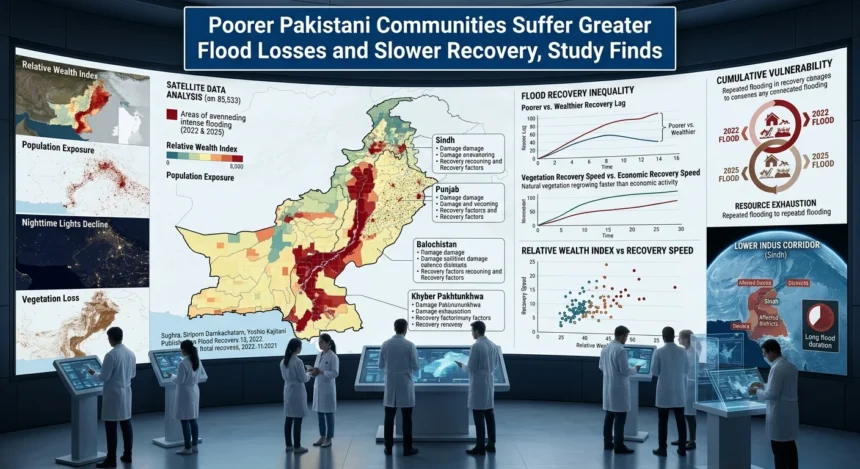
The researchers examined flood impacts across Pakistan using satellite data on nighttime lights, vegetation and population exposure. They studied 85,533 grid cells across the country, each covering about 4.4 square kilometres on average. Of these, 15,794 heavily flooded cells were matched with non-flooded areas for comparison.
Nighttime light data was used as a measure of local economic and social activity, while vegetation data was used to assess damage to crops and natural vegetation. Population data was used to determine how many people were exposed to flooding. The researchers also used a Relative Wealth Index to compare poorer and wealthier areas.
The study was conducted against the backdrop of the devastating 2022 floods, described in the research as the most severe in Pakistan’s recorded history. The floods affected 33 million people, caused 1,739 deaths and damaged or destroyed about 1.7 million homes. Agricultural losses alone were estimated at more than $3.7 billion.
The 2025 monsoon brought another major flood event before recovery from the 2022 disaster had been completed. According to the study, about 6.9 million people were affected and around 3 million were displaced. In Punjab, about 1.12 million hectares of crops were submerged, while around 230,000 homes and 4,700 villages were inundated.
The researchers found that the immediate damage from the 2022 floods was particularly severe for vegetation. Flooded areas recorded about 29 percentage points more vegetation loss than matched non-flooded areas. The impact was especially strong in agricultural areas of Sindh and Balochistan.
The study also found that, on average, 37.3 per cent of the population in flooded grid cells was directly exposed to inundation in 2022. The researchers said this was a descriptive measure of exposure rather than a separate estimate of the effect of flooding.
Nighttime light activity also declined in the 2022 flood year. The matched difference was 0.831 percentage points. However, the researchers said the result became statistically weaker under a stricter matching method. They cautioned that nighttime light data may not fully reflect the economic damage suffered by rural and low-income farming communities because such areas naturally have lower levels of nighttime light.
Recovery in economic activity appeared to improve in the years after the 2022 floods. Compared with matched areas, nighttime light growth was 2.904 percentage points higher in 2023 and 4.035 percentage points higher in 2024. However, the researchers cautioned that these improvements could not be explained by rebuilding alone because flood-affected and control areas were already following different trends before 2022.
The recovery was then interrupted by the 2025 floods. The year-to-year change in nighttime light growth from 2024 to 2025 was negative by 1.54 percentage points under the main comparison and negative by 2.31 percentage points when the researchers used areas that had not been flooded in either year as controls. In a separate analysis focused specifically on the 2025 flood, the reduction was estimated at between 2.12 and 2.86 percentage points.
Vegetation showed a somewhat different recovery pattern. By April 2023, flooded areas had reached 80 per cent of their earlier vegetation level at a higher rate than matched controls, with a difference of 3.644 percentage points. The advantage remained through October 2023, April 2024 and October 2024, when the differences reached 4.176, 4.244 and 4.292 percentage points respectively. However, the 2025 floods caused another 10.902 percentage points of vegetation loss.
The study found a clear link between wealth and recovery. Poorer areas experienced larger negative impacts or smaller improvements than wealthier areas. This pattern remained visible across the years, although the difference became smaller after the initial shock.
The relationship between wealth and the 2022 impact was statistically significant, with a Spearman correlation of 0.167. The correlation later fell to 0.060 in 2023, 0.071 in 2024 and 0.081 in 2025, while wealth groups continued to show the same general order.
The researchers identified several reasons why poorer communities may struggle to recover. These included limited access to formal financial services and credit, greater dependence on agriculture, weaker housing and reduced access to targeted public support. According to the study, repeated flooding can use up the money, assets and other resources that poor communities still have after an earlier disaster.
The study found that areas with lower wealth levels and the highest flood intensity were located in the same parts of the country, particularly in the lower Indus basin in Sindh. Districts with the longest flood duration in 2022 also had some of the lowest average wealth scores. The researchers said this showed that physical flood risk and socioeconomic weakness are closely located in several areas.
The provincial picture varied sharply. Punjab showed a strong recovery pattern, with nighttime light effects rising from 3.3 percentage points in 2022 to 10.0 percentage points by 2024. Agricultural recovery was also relatively stable. The study linked this pattern possibly to stronger infrastructure, higher wealth and greater institutional capacity, while noting that these were proposed explanations rather than proven causes.
Sindh showed a much weaker recovery pattern. Its nighttime light measure recorded a negative 6.2 percentage point impact in 2022, followed by almost no recovery in 2023 and further negative results in 2024 and 2025. Sindh also had the highest population exposure in the country in the study and a 52.4 percentage point vegetation loss measure in 2022.
Khyber Pakhtunkhwa showed a different pattern. Its nighttime light measure declined from negative 1.3 percentage points in 2022 to negative 7.1 percentage points in 2025, even though its vegetation recovery was strongly positive, ranging from 13.7 to 13.8 percentage points. The study said this difference showed that natural vegetation can recover faster than economic activity, which depends more heavily on infrastructure, transport, markets and formal employment.
Balochistan showed a delayed but continuing decline. Its nighttime light result was almost unchanged in 2022 but became negative 4.0 percentage points in 2024 and negative 4.4 percentage points in 2025. The province recorded the largest vegetation loss measure in 2022 at 66.0 percentage points, along with continued negative vegetation recovery results. The study linked this pattern to the province’s dry climate, fragile soils and limited irrigation, while presenting these factors as possible explanations.
Another major finding was the effect of repeated flooding. About 12.4 per cent of the grid cells studied, equal to 10,637 cells, were affected by both the 2022 and 2025 floods. These areas were concentrated mainly in the lower Indus basin in Sindh.
The researchers found that recovery in these areas was interrupted by the second flood and that repeated exposure produced cumulative effects rather than simply adding the damage of two separate events.
The study said the second flood can arrive before families, businesses and communities have rebuilt their homes, replaced damaged assets or restored their incomes. As a result, resources that would normally support recovery from the first disaster have to be used again for the second disaster. The researchers described this as cumulative vulnerability.
The researchers recommended that flood recovery should be monitored using several kinds of satellite information rather than relying only on economic activity indicators. They specifically highlighted vegetation data and the Relative Wealth Index as useful tools for identifying communities that face greater and slower recovery problems.
The study identified Kambar Shahdad Kot, Jacobabad, Kashmore, Larkana, Dadu and Shikarpur as low-wealth districts in the lower Indus corridor that have faced repeated flooding and may require targeted recovery and resilience investment.
It also called for disaster planning that considers repeated floods, including financing arrangements prepared in advance and infrastructure that can help shorten recovery periods.
The researchers stressed that the findings should be interpreted carefully. Because flooded and non-flooded areas had different trends before 2022, the study described its results as covariate-adjusted associations rather than proof that flooding directly caused every measured difference.
The researchers also said nighttime light data can understate agricultural damage, while the 2025 estimates remain provisional until more official post-disaster figures become available.
The study concluded that flood damage and recovery in Pakistan are not equal across society or geography. Poorer areas face greater losses and slower recovery, while a second flood before recovery is complete can make the situation worse. The researchers said future work combining satellite data with household surveys could provide a clearer picture of how disasters affect families at the individual level.