



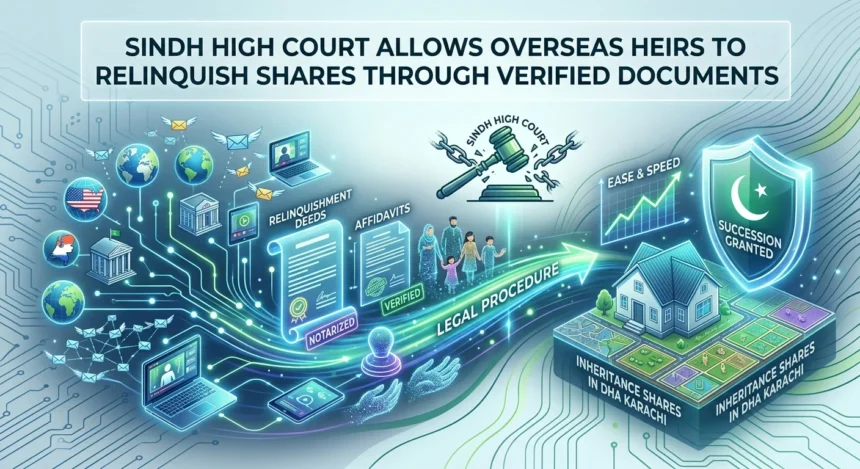
KARACHI: The Sindh High Court has held that legal heirs residing abroad may relinquish their inheritance shares in favour of another heir in non-contentious succession proceedings, provided the documents are properly verified.
The court ruled that notarised documents, supported by examination through video link in appropriate cases, can be accepted to facilitate overseas Pakistanis in completing inheritance matters without unnecessary hardship.
The ruling was passed by the High Court of Sindh at Karachi in MA No. 212 of 2024 on April 1, 2026. Advocate Asif Rasheed appeared for the appellant. The appeal was filed against an order dated November 19, 2024, passed in SMA No. 240 of 2024, whereby the Letter of Administration had been granted but the request for relinquishment of shares in favour of the appellant had not been accepted.
The high court noted that the succession proceedings had remained non-contentious throughout. A notice was published in a newspaper, but no person came forward to raise any objection.
The appellant’s counsel had relied upon two earlier decisions of the same court, passed in SMA No. 164 of 2015 and SMA No. 150 of 2018. However, the earlier court had not considered those decisions on the ground that they were unreported. It had also taken the view that the request for relinquishment of shares was beyond the scope of the succession proceedings.
The case related to the estate of Maqbool Ahmed, who died around 2019. His estate included several immovable properties situated in Defence Housing Authority, Karachi. After his death, and in the absence of objections, the properties were transferred among his legal heirs, including his son, his mother Rahat Naz, his daughters Nida Falak and Sana Falak, and his mother Sultana Begum.
After Sultana Begum later died, a separate succession matter was filed regarding her share in the properties. In that matter, several legal heirs submitted affidavits stating that they had no objection to the petition and were relinquishing, releasing and giving up their one-sixth undivided shares in favour of the appellant.
The heirs who submitted no-objection affidavits were Iqbal Ahmed, Muhammad Tariq, Rahat Naz Ahmed, Nida Falak Ahmed, Sana Falak Ahmed, Yasmeen Asif, Muhammad Jawed Ahmed, Muhammad Naveed and Aftab Ahmed Soomro. According to the order, all these heirs, except Mst. Nargis Akhter, were residing abroad. Their affidavits had been notarised.
The high court observed that the trial court had taken an additional step to verify the authenticity of the documents by examining the overseas heirs through video link. The court appreciated this practice, observing that it helped expedite matters involving Pakistanis living outside the country.
The court also examined the two earlier succession decisions relied upon by the appellant. In SMA No. 164 of 2015, the court had accepted relinquishment of shares by certain legal heirs after they executed separate relinquishment deeds attested by the Pakistan Mission abroad, as those heirs were living in the United States and the Netherlands.
In SMA No. 150 of 2018, the request for relinquishment had been accepted on the basis of formal no-objection affidavits filed by legal heirs and residuaries. Those affidavits contained a specific paragraph stating that the heirs were surrendering and relinquishing their shares.
The Sindh High Court held that the earlier court was not correct in ignoring those decisions merely because they had not been reported in law journals. It ruled that decisions of superior courts carry the same weight and legal effect whether reported or unreported, provided they are relevant to the matter under consideration.
The court further observed that the authenticity of an unreported judgment can be verified from the official court record. Since courts are courts of record, an unreported decision does not lose its legal value merely because it has not been published in a law report.
The high court also rejected the view that the request for relinquishment was outside the scope of succession proceedings. It held that such a request could be considered in the circumstances of the case.
On the question of inheritance, the court observed that a practical approach should be adopted in non-contentious succession matters, particularly where Islamic inheritance law is involved and some legal heirs are living outside Pakistan. The purpose, the court noted, is to facilitate overseas Pakistanis in completing legitimate inheritance arrangements without compelling them to travel unnecessarily.
The court then laid down two practical options for heirs who wish to relinquish their shares.
Under the first option, heirs may send properly executed relinquishment deeds which are notarised by a Notary Public and then endorsed and attested by the relevant Pakistan Mission abroad in accordance with the legal procedure.
Under the second option, where genuine practical reasons prevent compliance with the first procedure, the relinquishment deed may be notarised by a Notary Public and sent to Pakistan, provided the document clearly explains why the first option could not be followed. The court said that where the releasors have already been verified through video link, such documents under the second option would also be given full effect by government offices and authorities in Pakistan.
The ruling, therefore, provides a practical alternative for overseas heirs where attestation through a Pakistan Mission is genuinely difficult. However, the order makes it clear that proper notarisation, an explanation for not following the first procedure, and verification through video link remain important safeguards.
The Sindh High Court partly set aside the earlier order to the extent that it had refused to consider the unreported judicial precedents and the request for relinquishment of shares. At the same time, it maintained the remaining part of the earlier order granting the Letter of Administration.
The appeal was allowed to that extent. The court also directed that a copy of its decision be communicated to the judicial officer who had passed the earlier order.
The ruling provides guidance for succession cases where there is no dispute among legal heirs. It also clarifies that courts may use practical methods such as video-link examination to verify overseas heirs while ensuring that inheritance documents remain properly authenticated.
The decision is particularly relevant for overseas Pakistani families dealing with inheritance matters in Pakistan, as it offers a clearer route for relinquishing shares when heirs are living abroad, while retaining safeguards against false or unauthorised claims.
The order also establishes an important point for lawyers and lower courts that an unreported judgment of a superior court cannot be ignored only because it has not appeared in a law report. Its relevance and authenticity may be examined from the court record, and where applicable, it carries the same legal force as a reported decision.