




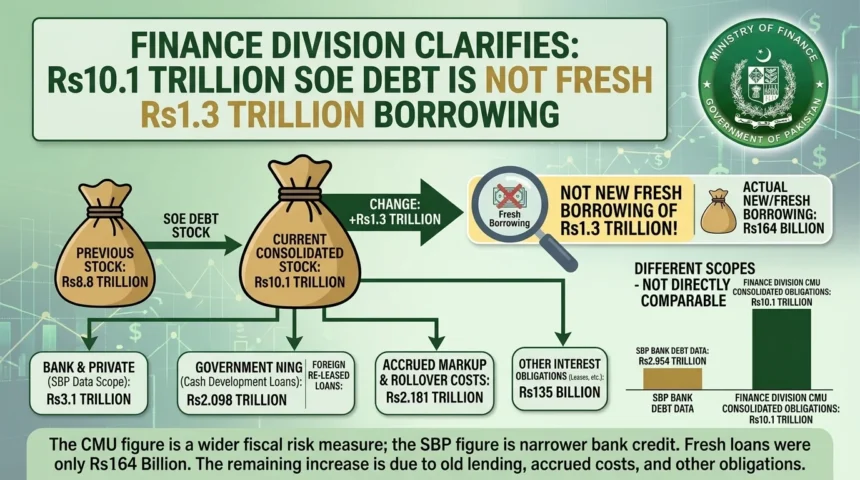
ISLAMABAD: The Finance Division has clarified that the reported Rs10.1 trillion debt of federal state-owned enterprises does not mean that these entities obtained Rs1.3 trillion in fresh loans during the reporting period.
In a clarification issued in response to a media report titled “SOEs’ debt soars to Rs10.1 trillion”, the ministry said the figure represented a broader measure of total interest-bearing obligations and should not be directly compared with the narrower bank debt figure reported by the State Bank of Pakistan.
The Finance Division said the report compared figures prepared for different purposes and with different coverage, which could create the impression that the entire increase in the debt stock represented new borrowing by state-owned enterprises.
According to the ministry, State Bank data mainly covers borrowing and credit obtained by public sector enterprises from the banking system. By contrast, the Central Monitoring Unit of the Finance Division uses a broader measure that records the consolidated stock of interest-bearing obligations of federal state-owned enterprises for monitoring fiscal risks faced by the government.
The Finance Division said State Bank data placed public sector enterprise bank debt at Rs2.954 trillion, while the Central Monitoring Unit reported combined obligations of federal state-owned enterprises at around Rs10.1 trillion. It stressed that the two figures differed in scope, coverage and reporting purpose and, therefore, should not be treated as directly comparable.
Giving a breakdown of the approximately Rs10.1 trillion figure, the ministry said Cash Development Loans accounted for Rs2.098 trillion, while foreign re-lent loans stood at Rs2.581 trillion. Bank and private loans accounted for Rs3.102 trillion.
The reported stock also included Rs2.181 trillion in accrued mark-up and rollover costs. Another Rs135 billion comprised other interest-bearing obligations, including lease and right-of-use related liabilities. Together, these amounts made up the approximately Rs10.1 trillion consolidated stock reported by the Central Monitoring Unit.
The Finance Division specifically clarified that Rs10.1 trillion was not the amount of bank borrowing by state-owned enterprises. It said bank and private loans represented approximately Rs3.1 trillion of the total. The remaining amount mainly consisted of government lending, foreign re-lent loans, accrued mark-up, rollover costs and other interest-bearing obligations.
The ministry also explained the difference between an increase in the total debt stock and fresh borrowing. It said the consolidated stock increased from around Rs8.8 trillion to Rs10.1 trillion, but this did not mean that state-owned enterprises raised Rs1.3 trillion in new debt during the reporting period.
According to the clarification, fresh or additional loans during the period amounted to approximately Rs164 billion only. The overall increase in the stock also reflected changes in older government lending and foreign re-lent loans, along with accumulated mark-up, rollover costs and other existing interest-bearing obligations.
The Finance Division said the distinction was important because the Central Monitoring Unit figure was designed as a wider fiscal risk measure, while the State Bank figure was a narrower measure of banking sector credit. It said combining the two measures could lead to an incorrect understanding of the actual movement in state-owned enterprise debt.
The ministry said the Rs10.1 trillion figure should be understood as the Central Monitoring Unit’s consolidated measure of interest-bearing obligations of federal state-owned enterprises. It added that the broader system was intended to give the government and the Cabinet Committee on State-Owned Enterprises a fuller view of the debt position of state-owned enterprises and the related financial risks.
The Finance Division’s clarification did not dispute the existence of the approximately Rs10.1 trillion consolidated obligation. Rather, it explained that the figure included several types of existing financial obligations and was not a record of fresh bank borrowing.
The ministry said approximately Rs3.1 trillion of the total represented bank and private loans, while fresh or additional loans during the reporting period were approximately Rs164 billion. The remaining amount included government loans, foreign re-lent loans, accrued mark-up, rollover costs and other interest-bearing obligations.
The Finance Division advised that the two sets of figures should be read according to their different purposes. It said the Central Monitoring Unit data was intended to provide a wider picture of the financial obligations and fiscal risks connected with federal state-owned enterprises, while the State Bank series focused on their borrowing from the banking system.