



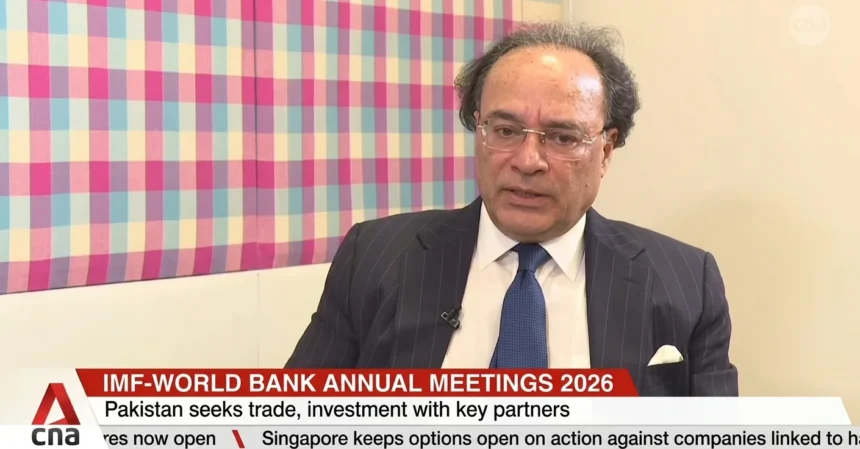
ISLAMABAD: Finance Minister Muhammad Aurangzeb has said Pakistan is shifting its economic policy from aid to trade and investment as it seeks to strengthen ties with China, the United States, Gulf countries and new regional markets.
In an interview with Channel News Asia in Bangkok on Wednesday, the finance minister said workers’ remittances were expected to rise from $41.6 billion last year to $44 billion this year.
Aurangzeb said Pakistan valued the support of its longstanding partners, particularly the Gulf Cooperation Council countries, which had helped the country through difficult economic periods. However, he said the country’s clear direction was now to increase trade, attract investment and build stronger economic partnerships instead of depending mainly on financial assistance.
The minister said Pakistan wanted to strengthen economic relations with all major partners while exploring new markets to increase exports, diversify imports and reduce the impact of global economic uncertainty.
He stressed that Pakistan did not see its ties with China and the United States as competing choices. “From our perspective, we are going to work with both of these partners very closely,” Aurangzeb said, adding that China remained a longstanding partner while Pakistan also wanted to expand economic cooperation with the United States.
Referring to China, he said the first phase of the China-Pakistan Economic Corridor had focused on major infrastructure projects, including roads, ports and power plants. CPEC, he added, was a key part of China’s Belt and Road Initiative.
Aurangzeb said the focus of CPEC Phase II was now shifting towards securing greater economic benefits from infrastructure already developed. The new phase, he said, would rely more on business-to-business cooperation, joint ventures and investment by companies.
He said some joint ventures with Chinese partners were already producing goods for export. The objective, he added, was to convert the infrastructure built under the first phase into new business opportunities, higher production and stronger export earnings.
The finance minister also said Pakistan wanted to improve economic ties with the United States. He noted that the country’s leadership had good relations with the US administration and wanted to use those ties to expand economic cooperation.
Aurangzeb identified the United States as Pakistan’s largest trading partner, followed by the European Union. He said the changing global trade environment offered Pakistan an opportunity to explore other markets with strong potential for trade in both directions.
He said cooperation between different regions was becoming increasingly important as global trade was becoming more divided and countries faced the effects of geopolitical tensions. Stronger regional links, he added, could help Pakistan protect its economy from sudden international shocks.
Pakistan, he said, was working to deepen economic cooperation with Gulf countries, Central Asian republics and members of the Association of Southeast Asian Nations. Aurangzeb referred to growing contacts with Malaysia and Indonesia, whose leaders had visited Pakistan, while Prime Minister Shehbaz Sharif had also visited Malaysia several times.
Speaking in Thailand, the finance minister said he was due to meet his Thai counterpart, providing another opportunity to discuss regional economic cooperation.
He said closer relations with Asian markets could help Pakistan find new buyers for its products, identify alternative sources of imports and create wider business opportunities at a time when international trade patterns were changing.
The minister also highlighted the importance of Gulf countries for Pakistan because of both trade and remittances. Pakistan received $41.6 billion in remittances last year and the government expected the amount to reach $44 billion this year.
Remittances sent home by overseas Pakistanis are an important source of foreign currency for the country. Aurangzeb said the close links between Pakistan and Gulf countries remained important for these money transfers as well as broader economic relations.
He said global economic difficulties could also create new opportunities for countries ready to expand their trading relationships. Pakistan intended to use stronger regional cooperation and wider international partnerships to increase trade, attract investment and make its economy more resilient.
The finance minister’s comments reflect the government’s stated aim of moving beyond economic stabilisation towards a model that depends more on trade, investment and production for export markets.