



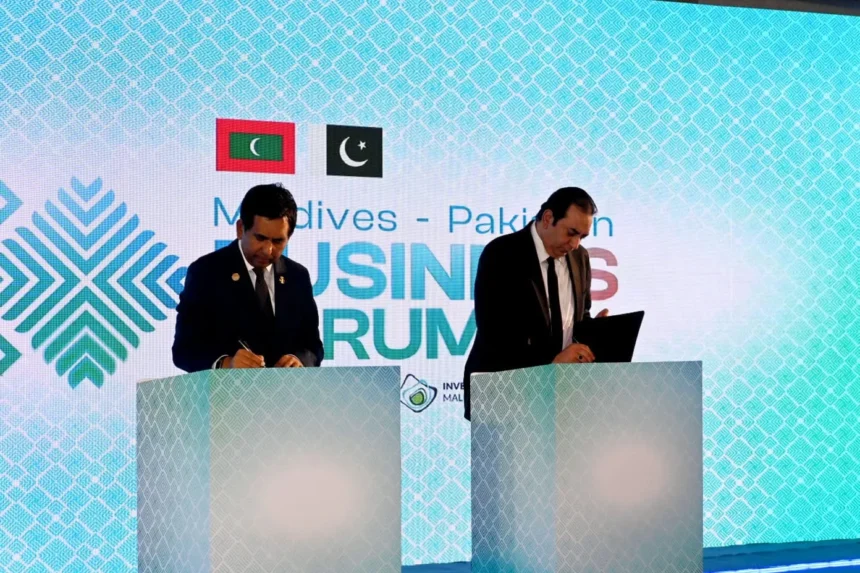
ISLAMABAD: Pakistan and Maldives have signed a memorandum of understanding (MoU) to promote economic and trade cooperation, with both sides agreeing to enhance trade, investment, business linkages and joint ventures.
The MoU on bilateral cooperation was signed on the occasion of the Pakistan-Maldives Business Forum by Federation of Pakistan Chambers of Commerce and Industry (FPCCI) President Atif Ikram Sheikh and the Maldivian Minister of Economic Development.
Prime Minister Shehbaz Sharif, Maldivian President Dr Mohamed Muizzu and senior officials from both countries attended the business forum.
FPCCI President Atif Ikram Sheikh termed the agreement an important milestone in bilateral relations between Pakistan and Maldives. He said the initiative had opened a new chapter of economic and trade cooperation between the two countries.
He said Pakistan and Maldives were committed to transforming their longstanding friendship into a strong trade partnership and direct contacts between the business communities of the two countries.
Addressing the Pakistan-Maldives Business Forum, Atif Ikram Sheikh said there were vast opportunities to increase bilateral trade and investment. He said tourism, fisheries, agriculture, food products and construction offered bright prospects for mutual cooperation, from which the business communities of both countries could benefit.
According to him, the private sectors of Pakistan and Maldives could support each other in different areas and help promote economic activities.
The FPCCI president said the federation was committed to increasing direct linkages between business enterprises of Pakistan and Maldives. He said exchanges of trade delegations and joint business ventures would be encouraged to increase mutual trade and investment.
Atif Ikram Sheikh expressed the resolve that the MoU signed between Pakistan and Maldives would not be confined to a documentary agreement, but would be translated into practical steps and measurable economic outcomes.
He said stronger cooperation between the private sectors of the two countries would not only increase bilateral trade and investment but also create new employment opportunities.