



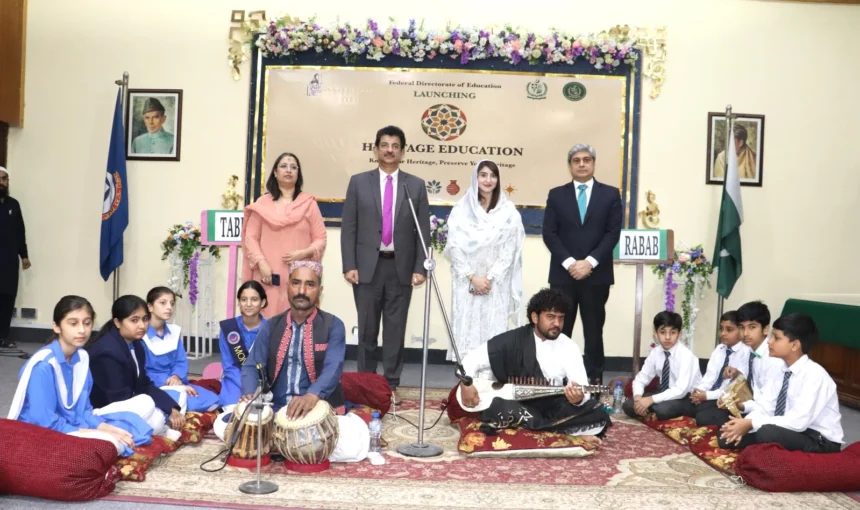
ISLAMABAD: The Ministry of Federal Education and Professional Training, in collaboration with the National Heritage and Culture Division, has launched the Heritage Education Initiative in Federal Directorate of Education institutions to promote cultural awareness, preserve traditional craftsmanship and strengthen students’ connection with Pakistan’s diverse heritage.
According to the ministry, the initiative will integrate heritage-based learning into the educational experience of students from Classes VI to VIII through practical engagement, creative exploration and experiential learning.
The pilot phase will be implemented in 10 public schools under the Federal Directorate of Education. Each school will establish a Heritage Club comprising 20 to 30 students.
The programme has been designed to complement the existing curriculum and will not introduce any additional subjects, examinations or graded assignments. Students will instead be provided opportunities to explore Pakistan’s cultural traditions through hands-on activities, research, observation and creative expression.
The initiative will focus on six traditional and contemporary craft areas: truck art, patchwork, jewellery making, clay pottery, rabab and digital art. Through these forms of artistic expression, students will learn about the skills, traditions and cultural narratives that have shaped Pakistan’s identity across generations.
The six-month pilot programme will follow a structured learning journey covering discovery, experience, creation and showcase. It will conclude with a student-curated exhibition, where participants will present their work, demonstrate their learning and share their understanding of Pakistan’s cultural heritage with the wider community.
The initiative will be implemented through a phased roadmap. The first phase will focus on piloting the programme and establishing proof of concept. The second phase will concentrate on consolidation and expansion, while the third phase will aim to institutionalise the initiative and ensure its long-term sustainability within the education system.
The ministry said the Heritage Education Initiative reflects its commitment to holistic education beyond conventional classroom instruction. By encouraging students to observe, question, investigate and reinterpret cultural traditions rather than merely memorise historical facts, the programme seeks to promote creativity, critical thinking, cultural appreciation and a sense of shared national identity.
Through Heritage Clubs, students will be encouraged to engage with the tangible and intangible dimensions of Pakistan’s heritage, recognise the value of traditional knowledge and craftsmanship, and explore ways to preserve and reinterpret these traditions in contemporary contexts.
The collaboration between the Ministry of Federal Education and Professional Training and the National Heritage and Culture Division highlights the importance of integrating cultural preservation with educational development. The initiative also seeks to strengthen intergenerational connections by introducing younger learners to traditional artistic practices and the cultural knowledge of local communities.
The ministry expects the pilot phase to provide insights into programme implementation, student participation and learning outcomes. These findings will help inform future expansion and the development of a sustainable framework for heritage education across federal educational institutions.
By bringing heritage into classrooms through practical and student-centred learning experiences, the initiative aims to nurture a generation that understands the significance of its cultural roots, values Pakistan’s diverse traditions and recognises its responsibility to safeguard this legacy for future generations.