



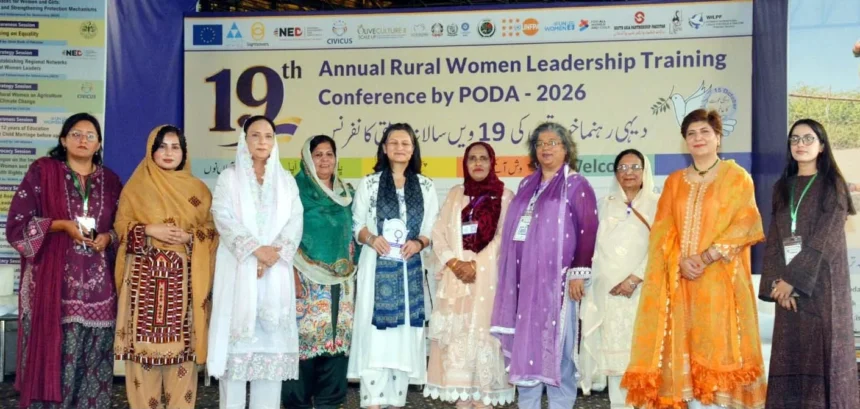
Rawalpindi-Islamabad (Staff Reporter): More than 600 rural women leaders from nearly 100 districts of Pakistan have called for effective measures to end discrimination against girls and women, prevent child marriage, promote education and ensure economic autonomy for women.
The demands were raised on the first day of the 19th Annual Rural Women Leadership Training Conference organised by the Potohar Organisation for Development Advocacy (PODA Pakistan). The three-day conference will continue from October 27 to 29, 2026, and is being attended by rural women leaders, parliamentarians, social activists, experts and representatives of various institutions from across the country.
PODA board member Mumtaz Askar welcomed the participants and appreciated the struggle and role of rural women in legislation for the elimination of child marriage. She stressed the need for effective implementation of laws passed in Punjab, Islamabad and other relevant areas, and called for practical steps for the protection of underage girls. She also termed family planning important for the health of mothers and children.
PODA Executive Director Samina Nazeer said that after legislation against child marriage, the real focus should now be on developing effective mechanisms that provide protection to underage girls and ensure implementation of their rights.
“Education is the foundation for preventing child marriage and empowering women,” she said.
In a session titled “Protection from Child Marriage through 12 Years of Compulsory Education,” Member of National Assembly and Secretary of the Women’s Parliamentary Caucus Dr Shahida Rahmani described education as indispensable for social change and national development.
She said rural women play an important role in agriculture, food security, the household economy and community development. However, she added, they continue to face several barriers in education, health, property ownership, legal protection, economic opportunities and participation in decision-making.
Former founding chairperson of the National Commission on the Rights of the Child and Chief Executive Officer of Human Capital Pakistan, Afshan Tahseen, highlighted the negative impacts of child marriage on girls’ health, education and autonomy. She stressed the need to increase women’s economic participation and provide them equal opportunities.
Dr Nishat Riaz of the Malala Fund described education as a key means of highlighting women’s capabilities and ensuring their effective participation in democracy. She recalled that PODA had introduced Malala Yousafzai at its conference in 2009 when she was only 12 years old.
Another key session focused on the need for a safe digital environment for women and girls. Senator Sana Jamali from Balochistan expressed concern over limited access to the internet and digital facilities in rural areas, particularly in Balochistan. She emphasised better internet access for women, online protection and responsible use of artificial intelligence.
Worth Tech Chief Executive Officer Mehreen Talha advised women to adopt precautionary measures to protect themselves from online harassment and financial fraud. She said women should not share their banking codes and PINs with anyone. In cases of online harassment, she added, they should preserve evidence, including screenshots, and file complaints with relevant platforms.
Assistant Chief Manager of the State Bank of Pakistan’s Banking Services Corporation Mania Bangash briefed participants on the Banking on Equality Policy for women’s financial inclusion. She highlighted the importance of increasing women’s representation in banks, providing dedicated financial facilities for women and improving their access to financial services.
Farmer Aqsa Meerwani from Awaran district in Balochistan shared her story of struggle and success. She is the first woman in her area to obtain land ownership. A recipient of the President of Pakistan’s Pride of Pakistan Award 2025, she has also been included by the UN Food and Agriculture Organisation among 100 women who have played a prominent role in agri-food systems and rural development.
Aqsa Meerwani stressed the need to establish centres for girls’ education and technical training in Khuzdar (Korak). She said the Amma Naeema Foundation, founded by her, is providing assistance to 1,264 individuals.
In the closing session, titled “The Voice and Representation of Pakistan’s Rural Women Leaders at COP31 Turkey,” participants demanded that education on climate change and natural disasters be made part of the curriculum from the school level.
The session, held in collaboration with the National Disaster Management Authority, emphasised that women’s needs should be prioritised in disaster planning, as rural women are more affected by climate change and disasters.
In his message, President Asif Ali Zardari expressed his commitment to creating equal opportunities for women in rural and underdeveloped areas and promoting their meaningful participation in economic, social and public life. He described women’s empowerment as a vital investment for Pakistan’s sustainable and prosperous future.
On the first day of the conference, rural women leaders also presented their issues, challenges and recommendations for possible solutions. Participants expressed their resolve to continue collective efforts for the protection of women’s and girls’ rights, promotion of education, elimination of child marriage, digital protection, economic autonomy and addressing climate change.