



ISLAMABAD: Lawmakers, energy experts and industry representatives have warned that Pakistan risks becoming a dumping ground for low-quality battery imports in the absence of proper safety checks, testing facilities and recycling rules, as battery imports rise sharply amid high electricity costs and growing stress on the national power grid.
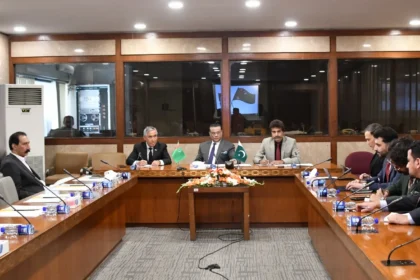
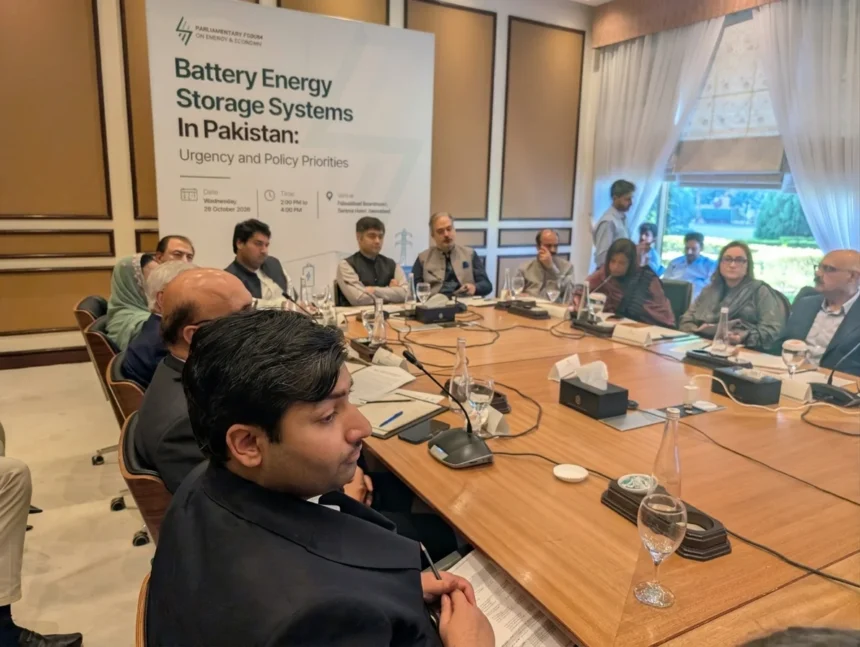
The warning came during a discussion held by the Parliamentary Forum on Energy and Economy at the Serena Hotel in Islamabad on October 28, 2026. Participants included MNA Sher Ali Arbab, MNA Dr Nafisa Shah, MNA Chaudhry Mubeen Arif Jutt, MNA Asad Alam Niazi, Sanaullah Baloch, Phullain Baloch, Power Division adviser Syed Faizan Shah and representatives of the energy sector.
The debate centred on Pakistan’s rapid shift towards battery storage, driven by households and businesses seeking relief from expensive electricity. However, speakers cautioned that the growing dependence on imported batteries, without a clear national framework, could create serious challenges related to product quality, safety, waste disposal and reliance on foreign suppliers.
A representative of the Pakistan Solar Association told the forum that Pakistan imported more than 4.5 gigawatts of battery storage equipment during the first six months of 2026. The forum’s accompanying statement compared this with a historical cumulative import figure of around 9.5 gigawatts, reflecting the speed at which the market has expanded.
Industry representatives said affordability remained a major concern. Engr Chaudhry Uzair, vice chairman of the Pakistan Solar Association, said a five kilowatt hour battery could cost around Rs250,000, making it unaffordable for many low-income families. He argued that ordinary consumers were moving towards solar panels and batteries because they needed cheaper and more reliable electricity, not because the equipment was easily within their financial reach.
The solar industry also blamed taxes and customs duties, estimated at 35 to 40 percent, for pushing up battery prices. Speakers warned that high duties on batteries and components could increase the financial burden on consumers without necessarily creating a strong local manufacturing base.
Uzair said Pakistan lacked a complete policy for battery system design. While some standards required batteries and cells to meet quality conditions, he said clearer rules were needed for the design, installation and safety inspection of complete storage systems. He also urged the government to include Pakistani engineers and the solar industry in official bodies framing battery policy.
Participants warned that Pakistan should not repeat the experience of solar imports by delaying local production until the market becomes heavily dependent on foreign products. They said local assembly alone would not be sufficient if the country continued importing most of the key components.
One speaker said around 85 percent of the world’s batteries were produced in China, while batteries from Europe and the United States could be 30 to 35 percent more expensive. The discussion stressed that incentives for local manufacturing should be designed carefully so that consumers are not forced to pay higher prices without meaningful industrial development.
The Power Division presented battery energy storage systems, commonly called BESS, as a possible solution to store surplus electricity during the day and supply it at night when demand rises.
Syed Faizan Shah said the government was preparing four pilot projects of 10 megawatt hours each at selected grid stations. The projects are intended to store excess electricity that flows back towards the grid during high solar generation periods and release it during nighttime demand.
The spoken presentation named LESCO, GEPCO, IESCO and MEPCO as the intended locations for the tenders, which the official expected to be launched within about 15 days. However, the forum’s accompanying statement listed LESCO, MEPCO, IESCO and PESCO, creating a difference in the fourth distribution company mentioned in the supplied material.
The official said the 2026 Indicative Generation Capacity Expansion Plan was being prepared with around 1,500 megawatt hours of battery storage. Of this, around 1,000 megawatt hours would be planned at the transmission level and another 500 megawatt hours across distribution networks.
According to the Power Division, battery storage could help stabilise the grid, reduce the need to build new gas-based power plants that operate only during peak demand, and lower dependence on imported coal and liquefied natural gas. The official said better storage could reduce the risk of loadshedding over the next two to three years, subject to implementation.
The Power Division said Pakistan faced a widening mismatch between falling overall electricity use and rising demand during a few evening hours. Peak demand in the national transmission system reached around 26,522 megawatts, according to the presentation, and could approach 29,000 megawatts when K-Electric was included. Daytime demand, in contrast, could fall to around 8,000 megawatts.
This pattern creates a costly challenge, as power plants and grid equipment are required to meet short peak periods even when they remain underused during much of the day. Officials argued that batteries could store cheaper daytime electricity and supply it during expensive peak hours.
The Power Division is also preparing an ancillary services framework to identify locations where storage is most needed and attract private investment. Regulations are expected to be developed by around April 2027. One proposed model would allow private companies to install batteries and provide storage services under contracts lasting 10 to 15 years.
Another proposal is to recognise battery storage as a regulated asset under the power sector framework. The Power Division official said this could allow batteries to be used instead of constructing costly grid stations or installing additional transformers when existing equipment becomes overloaded.
He cited the example of replacing a grid station costing around Rs1 billion with a battery installation costing about Rs500 million, potentially saving Rs500 million. The official said the required legal and regulatory changes were still being pursued. The forum’s statement described the move towards regulated asset status as a government initiative.
The question of who would pay for these projects remained a key concern. Participants warned that if utilities made large investments in battery storage and recovered the cost through electricity tariffs, consumers could face another financial burden.
A Power Division official said the government was considering time-of-use tariffs to encourage electricity consumption when supply was cheaper. Under the proposed approach, certain industrial users could receive rates of Rs6 to Rs9 per unit during selected periods. The official also gave an example in which an industrial tariff of around Rs30 per unit could fall to Rs22 for a consumer using electricity at a load factor above 50 percent.
The government is also exploring tariff refinancing and options allowing industries to buy electricity through direct contracts with suppliers. These measures are aimed at keeping businesses connected to the grid rather than pushing them towards private power systems.
Business representatives said high electricity prices were already forcing factories away from the national grid. One participant claimed that many Karachi industrialists had shifted to a mix of gas generators, solar panels and other private power systems, with electricity costs reaching around Rs42 per unit in some cases.
The participant also claimed that Sui Southern Gas Company’s gas consumption had fallen by about 50 percent over seven months as industries changed their power arrangements. He further alleged that K-Electric received gas at around Rs1,450 per million British thermal units while industrial users paid between Rs3,800 and Rs4,700, in addition to other levies. These figures were claims made during the discussion and were not independently verified in the supplied material.
MNA Chaudhry Mubeen Arif Jutt warned that businesses were spending money on captive power generation and storage instead of expanding factories, buying machinery or increasing production. He argued that some businesses were investing up to twice as much in their energy arrangements as in their production equipment.
Electric vehicles were also discussed. The Power Division said networks built for lower household electricity loads could face pressure when people charge electric cars at night. It suggested that battery storage could eventually be required alongside some electric vehicle charging systems to reduce the burden on transformers and the wider grid.
The official also referred to an electrification plan expected to be placed before the Cabinet. The plan would prioritise connecting areas located within about five kilometres of the existing grid. The government expects wider electrification and cheaper daytime power rates to increase electricity use and help balance demand.
The battery manufacturing policy being prepared by the Ministry of Industries was another major subject. The Power Division adviser said the policy could be announced within a month or two, with early incentives focused on assembly plants and raw materials. Participants, however, noted that making battery cells locally would take much longer and warned against treating simple assembly as full domestic manufacturing.
The discussion also highlighted concerns from Balochistan over centralised energy planning. Participants from the province said provinces and local communities were often excluded from decisions affecting their power supply and economic development.
Sanaullah Baloch said policies designed mainly in Islamabad failed to reflect the needs of rural communities, farmers and poorer regions. He said Balochistan had significant potential for wind and solar power, but provincial input was often missing from national energy planning.
He also said the provincial government had signed memorandums of understanding with international companies for solar projects of 10, 20 and 30 megawatts, but the proposals had remained pending in Islamabad for around 10 years. He urged the government to work with provincial assemblies and develop a national framework allowing provinces to design incentives according to their own needs.
Participants also raised the issue of lithium deposits in Balochistan and called for mineral resources to support local battery manufacturing and job creation. They said provincial governments should have a clear role in deciding how natural resources are used and how investment benefits reach local communities.
Another speaker said access to electricity remained unequal across the country and that national policy must take into account the different needs of urban centres, remote districts and poor rural households. Microgrids and minigrids were suggested as possible ways to improve electricity access in underserved areas.
The forum also heard that the expansion of battery storage must be planned alongside the growth of electric vehicles, data centres and other electricity-intensive sectors. Participants said the government needed to balance affordable electricity, reliable supply, grid stability, environmental sustainability and access for all communities.
The forum concluded that battery storage was becoming an important part of Pakistan’s power system, but required a clear legal framework, fair tariffs, safety standards and stronger coordination between federal and provincial institutions.
The proceedings will be compiled into a Parliamentary Working Paper for submission to the National Assembly Standing Committee on Energy, the Ministry of Energy, NEPRA and the Ministry of Finance. The paper is aimed at advancing changes in legislation, electricity tariffs and taxation.