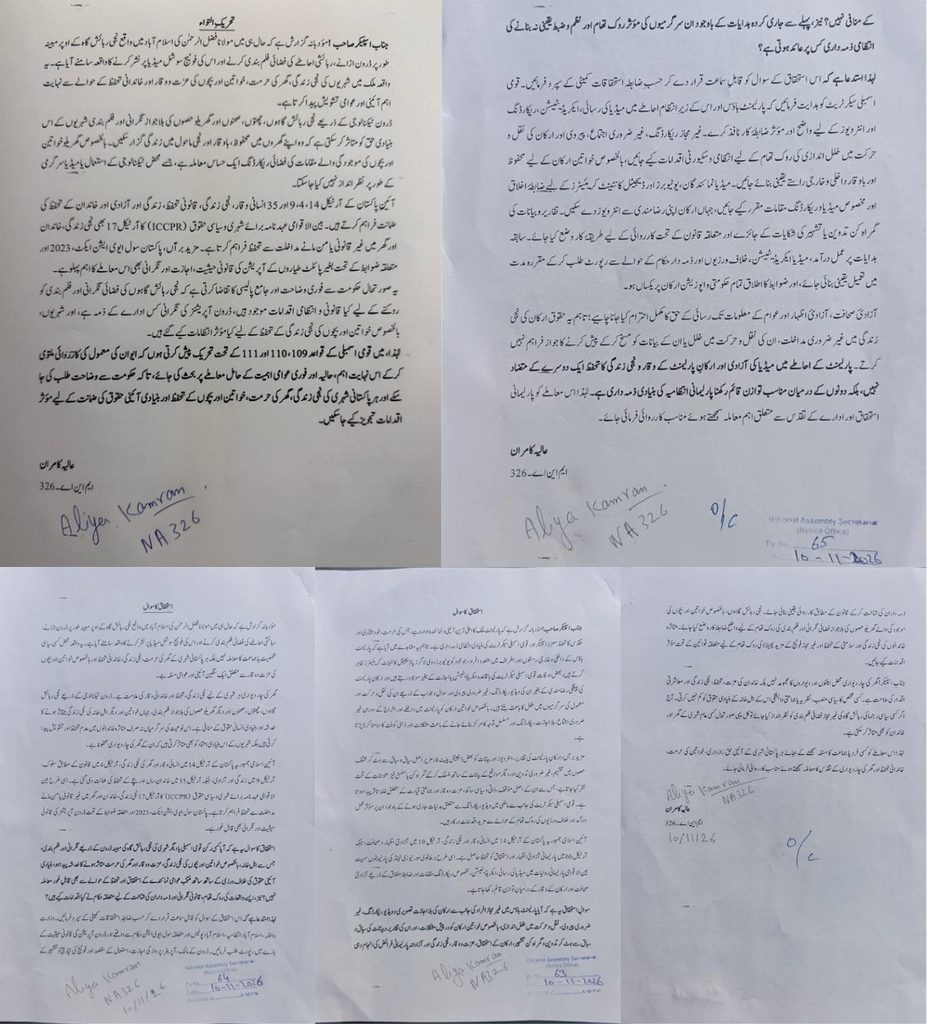





ISLAMABAD: Serious questions have been raised in the National Assembly over the alleged use of a drone to film the private residence of Jamiat Ulema-e-Islam chief Maulana Fazlur Rehman in Islamabad, with MNA Aliya Kamran demanding a formal investigation into the matter.
In a motion submitted to the National Assembly, Aliya Kamran sought details about who operated the drone, who authorised the flight, what its purpose was, and why footage of the private property was shared on social media.
She described the alleged drone surveillance and filming of Maulana Fazlur Rehman’s residence as a serious public and constitutional matter, not merely a political issue. The MNA warned that if such activities were allowed to continue unchecked, the privacy and security of political leaders, their families, women and children could be placed at risk.
Aliya Kamran stated that a family home is a private place where citizens have the right to live safely and with dignity. She argued that recording rooftops, courtyards and other private areas through drones without proper legal permission could expose family members, especially women and children, to unwanted attention and security threats.
The MNA asked whether filming a private residence through a drone without justification could amount to a violation of citizens’ constitutional rights, as well as the parliamentary privilege and security of public representatives.
In her motion, she referred to Article 14 of the Constitution, which protects human dignity and privacy; Article 4, which guarantees treatment in accordance with law; Article 9, which protects life and liberty; and Article 35, which calls for protection of the family, mothers and children.
She also cited Article 17 of the International Covenant on Civil and Political Rights, which protects individuals against unlawful interference in their private lives, families and homes.
The motion further raised questions about the Pakistan Civil Aviation Act, 2023, and rules governing drone flights and their monitoring.
Aliya Kamran demanded that the National Assembly Speaker refer the matter to the relevant Privileges Committee for examination. She also called for reports from the Ministry of Interior, Islamabad Administration, Islamabad Police and relevant civil aviation authorities to establish the facts.
She specifically sought identification of the drone owner and operator, details of flight permission, the purpose of the operation, and information about the recording and publication of the footage.
The MNA called for legal action against those found responsible and urged the formulation of clear rules to prevent unauthorised drone surveillance of private homes, particularly areas where women and children may be present.
She also demanded steps to stop the spread of unauthorised footage and protect the privacy and security of the affected family. She warned that if the alleged filming of a political leader’s home was ignored today, an ordinary citizen’s family could face the same situation tomorrow.
The motion stressed that a person’s political position, party affiliation or beliefs should not reduce the protection available to their family.
In a separate privilege matter, Aliya Kamran also raised concerns over the activities of YouTubers, vloggers and digital content creators around Parliament House.
She alleged that several individuals claiming to be digital journalists or online commentators were recording members of Parliament without proper accreditation or permission from the National Assembly Secretariat.
According to the motion, some individuals follow lawmakers around Parliament’s entrances and exits, record their movements and repeatedly question them without prior consent, disturbing their normal activities.
The situation was described as particularly difficult for women parliamentarians, who allegedly face unwanted gatherings, unauthorised recording and continuous attention while entering or leaving Parliament House.
Aliya Kamran also accused some digital platforms of cutting speeches, interviews and statements into separate clips and mixing them with remarks made on other occasions.
She said such editing and misleading headlines could create a false impression about what parliamentarians had actually said, damaging their personal and political reputations and creating misunderstandings about their positions and party leadership.
The motion noted that the National Assembly Secretariat had previously issued instructions regarding video recording, but said stronger action was needed to ensure implementation of the rules.
Aliya Kamran referred to Article 14 of the Constitution, which protects human dignity and privacy; Article 19, which guarantees freedom of speech and the press; and Article 66, which protects parliamentary freedom of speech and privilege.
She maintained that press freedom must be respected, but it should not be used to harass lawmakers, interfere with their movements or record them without proper permission.
The MNA demanded that the Speaker refer the matter to the Privileges Committee and direct the National Assembly Secretariat to introduce clear rules for media access, accreditation, recording and interviews inside Parliament House.
The motion called for specific places where media representatives, YouTubers and digital content creators may record interviews with lawmakers who voluntarily agree to speak.
It further demanded stronger security arrangements to prevent unauthorised recording, unwanted gatherings and harassment, with special attention to safe and respectful entry and exit arrangements for women parliamentarians.
Aliya Kamran also sought a proper system to examine complaints about misleading editing and publication of parliamentary speeches and statements, with action under relevant laws where violations are established.
She demanded a report on implementation of previous recording instructions, media accreditation, reported violations and the responsibility of officials tasked with enforcing the rules.
The motion stressed that the same rules must apply equally to treasury and opposition lawmakers.
It also referred to parliamentary practices in the United Kingdom and New Zealand, where media access, accreditation, designated recording areas and codes of conduct are used to balance press freedom with the dignity and privacy of elected representatives.