



By Dr Adil Saeed Qureshi
Abbottabad Public School, Abbottabad
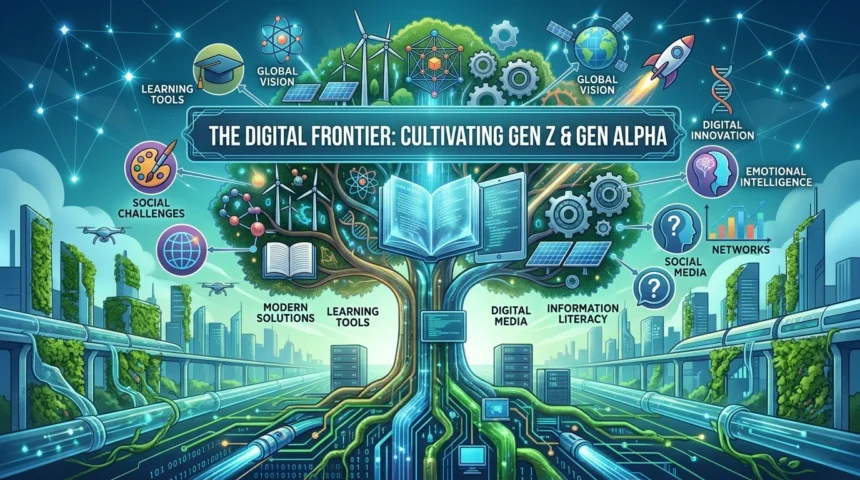
One of the important social and cultural questions of the present age is how parents and teachers should deal with Gen Z and Gen Alpha. Every new generation brings its own needs, aims and standards of interaction, but the case of these two generations is different because they have grown up in an age of rapid scientific progress, artificial intelligence, social media and screens.
Education has always been the most important instrument used by societies to refine human conduct and prepare individuals to become useful and civilised citizens. Formal and informal education have shaped minds and morals, and the real purpose of education has never merely been employment. Its broader purpose has been the formation of a society where people can live according to their values, faith and dignity, and where truth, honesty, justice, tolerance, respect, hospitality, service, reconciliation, forgiveness, good manners and broad-mindedness are upheld.
Human societies built institutions to strengthen social order and ensure continuity. Along with education, reward and punishment were adopted as tools for discipline. Language, customs and identity also became markers of social distinction. Yet despite differences among tribes, regions and generations, the higher human values remained common.
The industrial revolution set in motion changes whose present shape can now be seen in homes and schools. A generation is growing up before us which is identified not by lineage, language, tribe or region, but by its connection with social media, artificial intelligence and the screen. This generation is different from Millennials and Generation X in ways that are visible in everyday life.
Gen Z and Gen Alpha have been drawn away from the old patterns of life by the Android mobile phone, Kindle, laptop, computer and other screens. Many things for them have moved to a soft, digital form. Their social habits and cultural methods are changing, while the people around them remain attached to the models of the previous age. When parents and teachers do not see in children the manners and habits they themselves were trained to value, they become worried, confused and often angry.
Concern over change is understandable, but the difficulty begins when parents at home and teachers in classrooms judge these children only by old standards. They expect the same style of sitting, speaking, obeying and behaving which they themselves observed before their elders. When that does not happen, they feel as if a riddle has appeared before them. Parents, grandparents, uncles and teachers then begin to resent the non-traditional behaviour of Gen Z and Gen Alpha, and this resentment often turns into sarcasm, taunts and helpless anger.
The children, on the other hand, do not understand why adults are so disturbed by their screen time. They remember that the same adults introduced them to screens. Mothers handed them mobile phones while attending to guests and kitchen work. Fathers gave them mobile phones to protect their laptops while doing office work at home. Relatives kept them busy with phones. Food and bitter medicine were given while cartoons played on computers, laptops and mobiles. It is therefore natural for them to wonder why the same screen has now become a source of conflict.
In classrooms too, teachers are facing Gen Z and Gen Alpha with their own temperaments, experiences, training and energies. Students come with non-traditional intelligence, while many teachers continue to rely on old methods and formal classroom strategies. Teachers insist that they have obtained excellent board results through the same methods and that they possess decades of teaching experience and professional certificates. Students say that they may understand mathematics, but they do not understand why a teacher remains angry with them, why he or she is so strict, and why nothing they say seems to please the teacher.
These are questions to which educational psychology has answers, even if many classrooms have not yet found them. Earlier generations grew up with the authority of television news, PTV narratives and a more unquestioned view of the teacher. They did not know much about the political or sectarian leanings of a teacher. Gen Z and Gen Alpha do not necessarily read newspapers, and many are away from books and formal news, but they know that a teacher is not an avatar; a teacher is also a human being, with temperament, views and affiliations. They can sense these things from examples used in explanations and comments made during lessons.
This generation appears lonely, but it carries a world on its screen. In that world, it scrolls past anything it dislikes, disagrees with or finds irritating. When such an autonomous generation is placed before a traditional teacher and cannot scroll past a lesson, explanation, example or classroom talk it dislikes, it may disturb the class, whisper, exchange gestures, nudge one another or fail to bring homework the next day. If the teacher’s response is only the stick, a slap, a report or expulsion from class, the real issue remains unresolved.
The concern of teachers and parents is nevertheless valuable: how should children be introduced to their identity, nationality, language, religious learning, cultural values, civilisational traditions and social relationships? These children cannot simply be left to social-media information and commercialised activity on apps. Every society has its own temperament and the preservation of that temperament is important. The nurturing of the next generation’s thoughts and values remains the responsibility of parents and teachers.
Gen Z and Gen Alpha show stubbornness, insistence, rebellion, concern for privacy, bluntness, lack of traditional eye contact, distance from old forms of obedience, quick thinking, sharp replies, strong decision-making, high confidence, maturity beyond age, and early exposure to information. In a Pakistani society where many customs and traditions are already undergoing change and breakdown, this intelligent but less experienced generation needs care, training, counselling and guidance.
Parents and teachers meet this generation at the most important levels of life. In our Islamic and Eastern society, both institutions enjoy great authority. A sentence familiar to many Millennials was: “Teacher, the bones of this child are ours, the skin is yours.” Such licence produced harsh forms of punishment in the past. With time, and especially with the rise of private schools and changes in Pakistani law, punishment in schools has been stopped, though it may continue at individual levels in hidden forms. The reduction is real, but the old habit of harshness has not fully disappeared.
When such powerful institutions face a generation that challenges traditional authority, tensions naturally rise. In parent-teacher meetings, teachers often complain that the new generation is rude, careless and arrogant. Parents agree because the same behaviour is seen at home, where the authority of the mother and the dignity of the father also appear to be challenged. In this process, the individuality, intelligence and courage of these children are ignored. Taunts by mothers, reminders of sacrifice by fathers, distorted names used by teachers, and harsh treatment add fuel to the fire.
This is one reason the generation is turning towards loneliness. It often sees distance from relationships as safety and considers social obligations a waste of time. Its sense of humour has changed. Adults begin to make children feel as if they do not belong to this world and are creatures of another planet. The children, in turn, begin to seek refuge from both parents and teachers.
There is another reason for this distance. Parents and teachers frequently ask these children to create email IDs, download apps, fill forms, operate banking apps, transfer money between accounts, change passwords and help with digital tasks. After receiving such help, adults must also recognise the child’s psychological sense of difference. If this difference is not handled gracefully, it creates a gulf.
Gen Z and Gen Alpha are more blunt than previous generations. What is in their mind often comes directly to their tongue. Their confidence and intelligence give them a tool to express themselves. They enjoy leaving others speechless and share their amusement among themselves. They may not be socially active in gatherings, may be quiet before strangers and relatives, but on the screen they become complete performers.
The question, then, is how to build a relationship with them and prepare them for their own future, the dignity of their families and the future of the nation. This challenge concerns all societies, and some practical measures are necessary.
Parents, teachers and society must provide a better alternative to the screen. Children should also be given tasks on the screen in a meaningful way. A mother can ask a child to search for a skin cream, or to find information about Salahuddin Ayubi, Nuruddin Zangi, Sultan Osman Khan Turk, a treaty, the history of the Football World Cup, or the names of the Umayyad caliphs. At some point, the child may enter a reading activity without feeling forced. Similarly, a child can be asked to find a story or get a story written through artificial intelligence and narrate it.
In Pakistan, load-shedding may even be used as an opportunity. During that time, children can be engaged with the family. These children are often interested in the past of their parents. Old photographs should be taken out after some months and viewed together. Parents can speak about their village, city, college, university, business, labour, weddings of their time, childhood games, hairstyles, clothes, food, and time spent with siblings. Such memories can show children the importance of family life.
Parents should make outdoor plans with children. They can visit their city, village, a building, a place or a bazaar so that children come out of a hypnotised environment. Infants should not be made dependent on mobile phones; lessons should be learnt from older children who became habitual users.
The importance of family must be highlighted for Gen Z and Gen Alpha. Parents should participate warmly in weddings, engagements and other family functions, and should take children along. After returning, they should not start criticising relatives in front of the children. If children refuse to attend such events, they should be dealt with calmly and gently. Parents may insist, but should not irritate them, quarrel with them, curse them or taunt them.
Their conversation must be heard with the same attention with which adults want their own words to be heard. This generation has deep observation and strong decision-making ability. It can also withdraw a decision through argument without feeling ashamed. Therefore, adults should neither speak to them carelessly nor listen to them without attention. They will do what they see.
Parents and teachers must make them feel that adults are eager to speak to them, not merely angry with them. Positive presence is essential. When children are busy on the screen, they may be given peeled and cut apples, tea and biscuits, washed grapes or a piece of cake with a smile. Before giving them a task, they may be told gently: when you are free, clean this room; when you get up, take out your dirty clothes.
Lack of eye contact while speaking should not be treated as a major issue. If a child is upset, sad or worried, and shares something, laughing at the child may distance him or her permanently. Teachers should use humour, affection and warmth, and avoid traditional harshness and anger.
This generation needs time. Adults should talk to them, address them softly and avoid cutting them off, because they will then also cut off the adults. They must be guided with affection rather than scolding, with praise rather than insult, with trust rather than sarcasm, and with better use of time rather than constant complaints about wasting time. Advice should not be forced repeatedly in a way that irritates them; it should be given wisely.
Parents and teachers should speak to them about new words and new directions, care for them, trust them, teach them the difference between good and bad without unnecessary generalisation, ask their opinion and give it importance. They should be taught dignity in refusal, patience in anger, self-respect and proper expression. They should be asked questions and encouraged towards prayer; they may be taken along for Friday prayers. Adults also need to unlearn some habits and examine their own tone.
Gen Z and Gen Alpha are a source of energy and great potential. They are enclosed in screens, but parents, teachers and society must allow them to grow with wisdom, patience and understanding. They must be made aware of the demands of their own age, but gently and intelligently, so that they can learn from the reason, wisdom and manners of the generation before them.
It is also clear that this generation is learning a great deal where it currently is. It is learning the four basic skills of language. It is becoming acquainted with English, an essential need in Pakistani society. It has an enviable store of information, a sense of debate and a method of argument. It recognises social good and evil in an impressive way, and understands human beings, though its knowledge and inclination regarding relationships is weak. Its tendency towards loneliness is strong, but it is aware of the spirit of life. In a controlled environment, it remains relatively safe from many social harms. In the absence of playgrounds, and because of unhealthy club environments, the screen has also kept many children within the home. This generation has remarkable analytical ability.
In short, excess of anything and shortage of anything can make human beings weak, dependent and disabled. The relationship of parents and teachers with Gen Z and Gen Alpha is one of the major questions of the present age. It can be resolved if softness, patience, tolerance and forbearance are not abandoned. Otherwise, God forbid, the new generation may fall victim to loneliness, and human beings may no longer be able to live with one another. Human beings are, after all, the companionship and remedy of other human beings.
Dr. Adil Saeed Qureshi is an educationist, short-story writer, columnist, literary critic, and researcher. He currently serves as the Head of the Urdu Department at Abbottabad Public School and College, Abbottabad. Alongside his academic pursuits, he remains deeply engaged with the literary and cultural life of the region, serving as the Editor of Likhtaan, a Hindko literary magazine published from Abbottabad.
He is the author of six books, spanning fiction, cultural studies, literary scholarship, and regional literature. His published works include two collections of short stories, چاند روتا سورج and فسانے افسانے; پاکستان اور پاکستانی ثقافت; کلیاتِ پرواز تربیلوی (compiled); صوفی عبدالرشید: احوال و آثار; and ہواڑاں (ہندکو افسانے). Four more books are scheduled for publication in the coming months.
In addition to his literary and academic contributions, Dr. Qureshi is an experienced master trainer and an executive member of several distinguished literary societies. His work reflects a sustained commitment to education, literary expression, critical inquiry, and the preservation and promotion of the region’s linguistic and cultural heritage.
adelsaeedq@aps.edu.com (0321-9834855)