



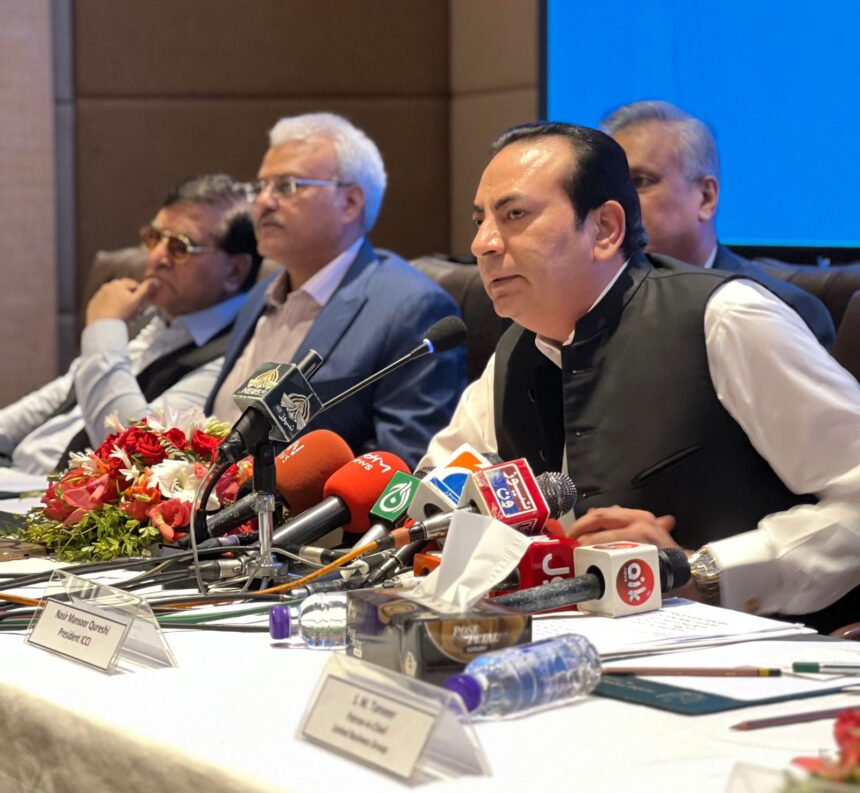
Leading figures from Pakistan’s business community have called for urgent and comprehensive reforms to address the country’s ongoing economic challenges. At a high-profile press conference, heads of key business associations emphasized the need for sustainable economic growth, administrative restructuring, and strong collaboration between the government and private sector.
Nasir Mansoor Qureshi, President of the Islamabad Chamber of Commerce and Industry, described Pakistan as being at a critical crossroads, facing significant economic challenges. He stressed that the path to sustainable growth requires structural reforms and resolving long-standing issues. Qureshi underscored the business community’s readiness to actively support the government in restoring economic stability, noting that businesses are key stakeholders in the nation’s economic recovery.
Atif Ikram Sheikh, President of the Federation of Pakistan Chambers of Commerce and Industry (FPCCI), echoed these concerns and advocated for meaningful steps to revive the economy. He expressed full support for the creation of new provinces to ensure the benefits of development are distributed more widely, and called for a new administrative structure across provinces to better serve Pakistan’s large population. Sheikh highlighted the importance of promoting district-level economies and argued that the current administrative setup is unable to address the needs of a growing nation.
Sheikh also called for urgent measures to lower the interest rate to single digits and reduce electricity costs to support business activity. He emphasized the necessity of infrastructure improvements and insisted that the privatization process must be completed without further delays. Outlining an ambitious vision, Sheikh announced FPCCI’s mission to boost exports to 100 billion dollars by 2030, stating that enhancing the local economy is critical for achieving this target. He reiterated that the business community stands firmly with the government in efforts to fully revitalize Pakistan’s economy.
S M Tanveer, Patron-in-Chief of the United Business Group (UBG), highlighted Pakistan’s significant economic potential, claiming that each sector has the ability to contribute five billion dollars in exports. He commended Special Assistant Haroon Akhtar Khan for developing a robust industrial policy, while also drawing attention to Pakistan’s lag in comparison to India’s larger economy. Tanveer lamented the steep decline in cotton production and the country’s failure to add value across industries, particularly agriculture.
Addressing Pakistan’s fiscal challenges, Tanveer pointed out that a one percent reduction in interest rates could save the government 3500 billion rupees in debt repayments. He highlighted the 40 billion dollar trade deficit and the annual loss of 12 billion dollars in interest payments, contrasting this with the government’s appeal to the IMF for just six billion dollars.
Tanveer concluded by honoring the armed forces and urged leaders to tackle the economic front with the same resolve shown in defense matters, insisting that Pakistan must also triumph in the “battle of the economy.”