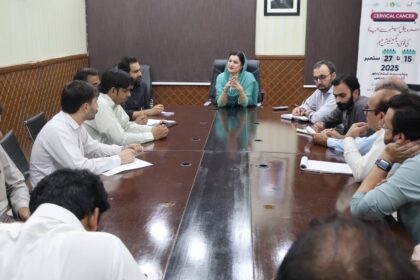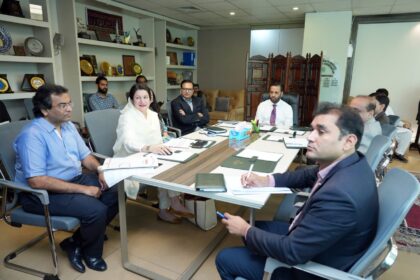





The Institute of Strategic Studies Islamabad hosted former Chief of the Naval Staff Admiral (R) Zafar Mahmood Abbasi for a Thought Leaders Forum on maritime security and the blue economy, in a session framed by the aftermath of the May 2025 conflict. Director General ISSI Ambassador Sohail Mahmood said the discussion aimed to link naval power with economic opportunity and to chart a realistic course for harnessing Pakistan’s maritime potential.
Ambassador Sohail Mahmood stressed Pakistan’s geo-economic and geo-strategic importance and identified three pressing challenges for the maritime domain: strategic competition in the Indian Ocean Region including India’s naval modernisation, non-traditional threats such as piracy, terrorism and trafficking, and intensifying geopolitical rivalries as major powers seek influence. He urged policymakers to shift from a primarily continental outlook and to prioritise maritime security as central to national strategy.
Speaking on the blue economy, the DG highlighted structural weaknesses that impede progress: an inadequate regulatory framework, fragile institutions, limited maritime infrastructure, security concerns, technological gaps, scarce specialised human resources, and economic uncertainty. He called for close collaboration between government agencies, the Pakistan Navy, industry, academia and civil society to build capacity and translate the maritime advantage into tangible economic gains.
Admiral (R) Abbasi argued that Pakistan’s maritime domain has been long neglected and noted wider global imbalances between the Global North and South that affect maritime governance. He emphasised that maritime security underpins both defence and economic growth, and identified India as the principal conventional threat that necessitates robust seaward defences and credible deterrence. The admiral also described the lack of a Pakistan Navy base at Gwadar as a strategic gap that merits attention.
In peacetime the Pakistan Navy contributes to regional stability through participation in Combined Maritime Forces operations, Regional Maritime Security Patrols, and coordination under NAVAREA IX and search and rescue frameworks. Progress since the creation of Coastal Command in 2005 and deployment of Pak Marines in 2018 has strengthened coastal defences, while the Navy’s roles in CTF-150 and CTF-151 demonstrate its contribution against terrorism, piracy and drug trafficking.
On economic prospects, Admiral Abbasi and ISSI speakers recalled the 2015 expansion of Pakistan’s Exclusive Economic Zone and extended continental shelf, achieved with the Pakistan Navy and NIO. Those maritime zones hold untapped oil, gas and mineral potential. Reviving shipbuilding and boosting indigenous shipping could reduce foreign exchange outflows, while addressing overfishing, pollution and weak regulation in the fisheries sector would improve export earnings and support coastal communities.
The address concluded with a robust question and answer session that engaged scholars, diplomats and policy experts on the practical steps needed to secure maritime space and develop the blue economy. A memento was presented to Admiral (R) Abbasi by Ambassador Khalid Mahmood, underscoring the forum’s focus on strengthening maritime security and institutional coordination as central pillars of national policy.