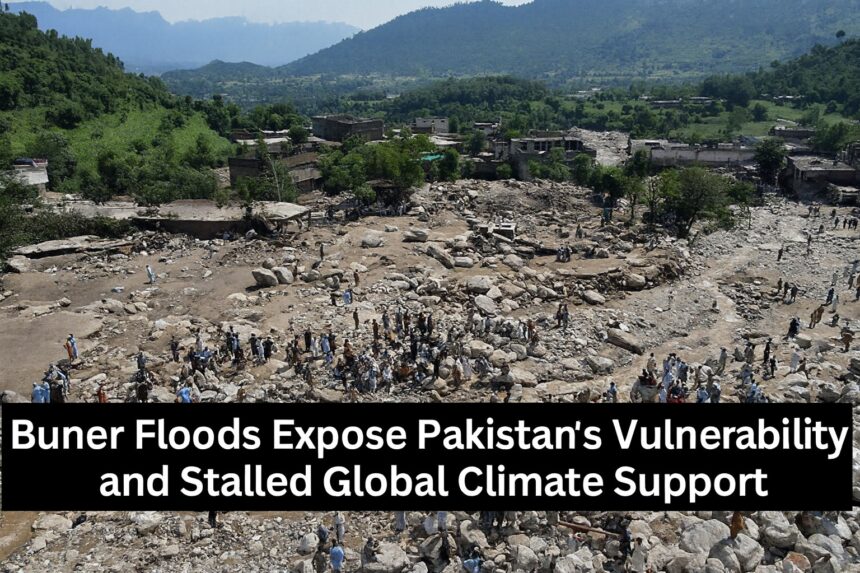
Buner Floods Expose Pakistan’s Vulnerability and Stalled Global Climate Support
by Waris Paracha
Buner Floods Reveals Stalled Global Support
My dreams and savings. Everything was drawn with flood; this word was paid by Shahid, who is the resident of Buner. His eyes have many questions but no words.
Unfortunately, we are typically ignorant and always remain ready to challenge nature and its Natural phenomena. Shahid is not alone in his town; there are thousands of people in the whole country who are suffering from natural disasters.
The important thing is that climate-induced destruction occurs in both quantum and frequency. It is serious to realize the impact of climate on economic value to develop effective mitigation and adaptation policies. Climate change is a global issue and has become a critical cause of concern for nations.
The alarming thing is that many advanced countries are also contending with environmental deterioration. Pakistan is the major victim of Climate change after shocks.
After the flood, heart-rending stories become the source of news, Dead bodies and household things floating everywhere. According to a Dawn News report published on April 28, 2024, a 1.2-degree Celsius intensification in global temperatures and exacerbated by factors such as melting Himalayan glaciers and land-use changes, inflicted staggering damages, estimated at Rs3.2 trillion (USD 14.9 billion), with recovery needs soaring to Rs3.5 trillion (USD 16.3 billion).
After one year, the result is the same, and the flood has become a seasonal phenomenon now.
As per the Nationwide Overview on August 20, Pakistan has suffered over 750 monsoon-related deaths, including 385 fatalities in the northwest from flash floods.
Further added that a few days earlier, on August 18, reports indicated more than 660 deaths since late June, with over 360 occurring in just the preceding four days.
Provincial Breakdowns are showing dangerous stats, especially KP has been a severely impacted area. On August 16, death toll estimates in KP had already reached 332, with Buner again highlighted as the hardest-hit district
The PDMA confirmed 385 deaths in KP by August 21, alongside 182 injuries, with Buner district alone accounting for 228 fatalities.
At the National level stats results are horrifying, as per Pakistan’s National Disaster Management Authority estimates that nearly 750 people have died (NDMA), 965 were injured
At least 123 deaths in Punjab; 10 deaths in Karachi reported.
An Alkhidmat Foundation report (as of July 23) noted 245 deaths, 603 injuries, 913 homes damaged, 240 livestock lost, and thousands displaced.
Intensifying monsoon patterns, causing sudden, heavy bursts of rainfall that overwhelm infrastructure cause of Climate Change.
According to reports over the past fifteen years, Pakistan has faced one climate disaster after another. The 2010 “super floods” displaced nearly 20 million people and claimed almost 2,000 lives. In the decade that followed, recurring monsoon floods in Khyber Pakhtunkhwa, Gilgit-Baltistan, and Punjab disrupted communities repeatedly, laying bare unlawful riverbank encroachments and the weakness of public infrastructure.
The terrible floods of 2022 once again drew global attention—33 million people were affected, more than 1,700 lives were lost, and the economic toll was estimated at 30 to 40 billion US dollars. Now, in 2025, the people of Buner have become the latest victims of this relentless cycle, their suffering another stark reminder of the climate injustice Pakistan continues to bear.
Scientists have long clarified the underlying processes. Rising temperatures allow the atmosphere to hold greater amounts of moisture, which is then unleashed in sudden, intense downpours. Pakistan’s glaciers—among the biggest outside the polar regions—are retreating rapidly, creating thousands of precarious lakes that may overflow or burst unexpectedly. But these natural risks are compounded by human behavior: rampant deforestation strips hillsides of protection, haphazard urban expansion obstructs natural waterways, and unlawful construction narrows river channels.
On the other hand, this is where global solidarity becomes crucial. The United Nations Framework Convention on Climate Change (UNFCCC) established mechanisms precisely to respond to such crises.
At COP27, nations committed to setting up a Loss and Damage Fund, intended to direct resources to vulnerable countries bearing the brunt of climate-induced disasters. Yet, years on, much of that promised support has still not reached the communities that need it most.
The main thing is what Pakistan needs to do in a vulnerable condition, what Pakistan’s Responsibilities are to deal with this type of crisis. While international financing is vital, Pakistan must also address its own internal shortcomings.
Repeated disasters have made it clear that lessons are not being learned. Waterways remain obstructed by unlawful encroachments, forest cover is still alarmingly scarce despite reforestation drives, building regulations are weakly implemented, and disaster management continues to suffer from inadequate funding. Pakistan should work hard on it so that it can cop with human disasters.