




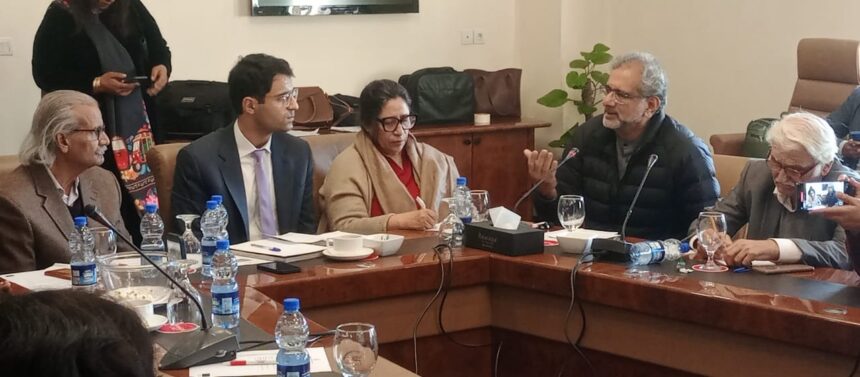
Speakers at a packed roundtable organised by the Human Rights Commission of Pakistan warned that the Prevention of Electronic Crimes Act 2016 and its amendments have a suffocating effect on ordinary citizens and journalistic work, and urged a broad civil society response to defend digital expression.
Moderated by lawyer Azwar Shakeel, the session formed part of HRCP’s campaign Ten years of PECA, ten years of silence, where PFUJ president Afzal Butt called for principled opposition to rights-curtailing measures and proposed direct, sustained dialogue with authorities to separate necessary regulation from repression.
Veteran journalist and HRCP council member Nasir Zaidi traced the state’s long-standing restrictive approach to speech, arguing that successive laws including PECA have been used to control narratives rather than uphold constitutional freedoms. Journalists at the roundtable described structural pressures on the media, with Akbar Notezai pointing out how newspapers in Balochistan rely heavily on state advertising, undermining editorial independence and increasing vulnerability to coercion under the PECA framework.
Matiullah Jan warned that involving other security agencies in PECA-related FIA investigations risks widening the scope for abuse and eroding due process. Several participants recounted incidents of harassment and intimidation by FIA officials, raising serious concerns about corruption, lack of accountability and the chilling effect on reporting and online speech.
Speakers including lawyers Saqib Bashir and Asad Toor urged coordinated, evidence-based litigation across multiple courts as one pillar of response, while stressing that legal action alone will not be sufficient. Former prime minister Shahid Khaqan Abbasi joined calls for resisting laws that restrict press freedom and emphasised the need for political engagement alongside public mobilisation.
Former senator and HRCP council member Farhatullah Babar proposed forming pro bono legal teams to pursue due process violations under PECA and suggested structured engagement with political parties to build consensus on safeguards. His proposal to publicly identify officials responsible for abusing these laws was endorsed by Tariq Ali, president of the Rawalpindi Journalists Union, as a measure to improve accountability.
Participants concluded that defending digital expression requires a mix of strategic litigation, sustained public debate and a united civil society coalition. The consensus at the roundtable was clear: reform of PECA and stronger protections for free speech are urgently needed to protect journalists, online users and the democratic space in Pakistan.
Asad Iqbal Butt, Chairperson