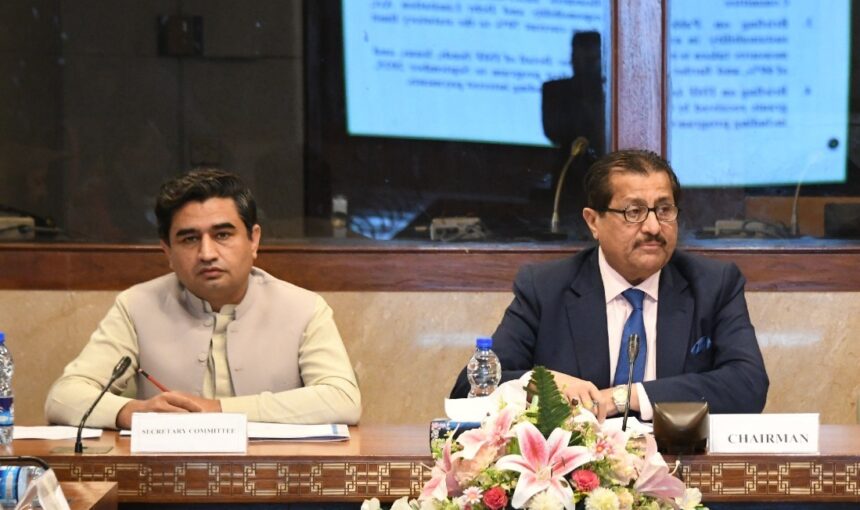
The National Assembly Standing Committee on Economic Affairs has demanded the immediate inclusion of the Lyari Freight Corridor in the Public Sector Development Programme, warning that the long-delayed project must not face further obstruction. Members said the corridor is a national priority that will improve freight movement, ease congestion in Karachi and strengthen Pakistan’s logistics backbone.
The committee stressed that PSDP funding is more reliable than the Public–Private Partnership mode and directed the Ministry of Communications and the Karachi Port Trust to jointly explore all viable options to advance the Lyari Freight Corridor. Members proposed holding the next session in Karachi to inspect the route on the ground and engage local stakeholders to identify practical implementation strategies.
The Ministry of Finance provided an in-camera briefing on the ongoing IMF assistance programme, prompting serious concerns about the current definition of public debt. Committee members argued that the official measure does not fully reflect the country’s borrowing obligations and asked that all forms of government borrowing be included to present an accurate debt profile. They also demanded greater clarity on how the primary surplus is being used for debt retirement to distinguish repayments from new borrowing.
Committee members voiced alarm over rising taxation on the industrial sector, with effective rates approaching 60 percent in some cases. Officials reported that several industries have scaled back operations or relocated abroad in response to heavy taxes, undermining competitiveness, investment and employment while ultimately reducing state revenue.
The Economic Affairs Division delivered a detailed presentation on foreign training programmes for government officials covering governance, public finance and energy, among other subjects. The programmes, supported by partners including Japan, China, the United States, Türkiye, JICA, the World Bank and UNDP, are intended to enhance technical capacity and leadership. EAD said selections are based on merit, professional relevance, educational qualifications and gender balance, with final approval by its Foreign Training Committee.
Reviewing regional nominations, the committee noted that 19 candidates were selected from Sindh out of 139 applicants, 58 from Khyber Pakhtunkhwa out of 178, 64 from Balochistan out of 300, 33 from Azad Jammu and Kashmir out of 86, and 52 from Punjab out of 198. Concerned by Sindh’s relatively low selection rate, members directed EAD to provide a detailed explanation and prepare a guidance note to improve future nominations from the province, urging balanced participation to support national capacity building.
The committee emphasised that timely PSDP allocation, transparent debt reporting and a review of industrial taxation are essential to ensure projects like the Lyari Freight Corridor deliver the intended economic and social benefits for Karachi and the wider federation.