




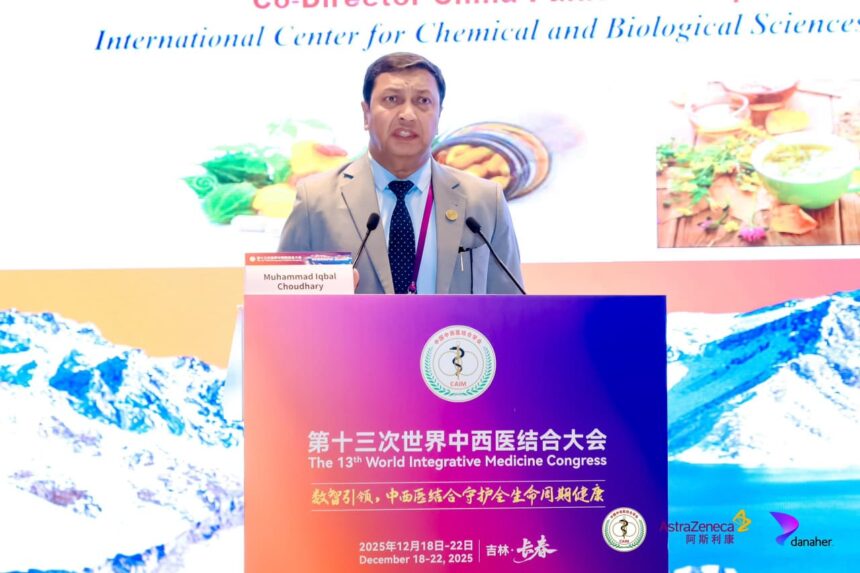
Prof. Dr. Muhammad Iqbal Choudhary, Coordinator General of OIC-COMSTECH, presented a detailed keynote at the 13th World Integrative Medicine Congress (WIMCO 2025) in Changchun, China, arguing for wider adoption of evidence-based traditional approaches in modern healthcare. He framed Traditional Medicine as a viable pathway to address affordability, access and drug insecurity that many developing countries continue to face.
Delivering a lecture titled “Traditional, Complementary, and Integrative Medicine: Therapeutic Options to Overcome the Global Disease Burden,” Prof. Dr. Choudhary warned that the prevailing drug discovery model is increasingly unsustainable and non-inclusive. He noted that for a large share of the global population, especially in low and middle-income countries, traditional and complementary therapies remain the primary source of care.
Responding to the question of whether traditional medicines can fill existing gaps, he emphasised that evidence-based Traditional Medicine and integrative care can serve as first-line treatments for many conditions, support disease prevention and play a key role in managing chronic illnesses. He highlighted the inherent sustainability of natural-product based therapies and their structural diversity as important assets for healthcare systems seeking affordable, long-term solutions.
Prof. Dr. Choudhary also referenced the World Health Organization recommendation for member states to integrate Traditional, Complementary and Integrative Medicine into mainstream systems. He argued that such integration can reduce health inequities, improve national resilience and strengthen public health outcomes across diverse populations.
Highlighting Pakistan-China scientific cooperation, he described ongoing initiatives between OIC-COMSTECH and leading Chinese institutions. The establishment of the Sino-Pakistan Cooperation Centre on Traditional Medicine at the International Centre for Chemical and Biological Sciences, University of Karachi, was presented as a model for South-South collaboration to advance evidence generation and capacity building in Traditional Medicine.
He further detailed COMSTECH partnerships with Hunan University of Chinese Medicine, Ningbo University, the China Science and Technology Exchange Center, Huawei Technologies and Xinjiang Medical University aimed at promoting research, innovation and knowledge sharing in traditional medicine and biotechnology. The lecture closed with a call for strengthened international partnerships, interdisciplinary research and policy support to harness the potential of Traditional Medicine for global health and sustainable development.