



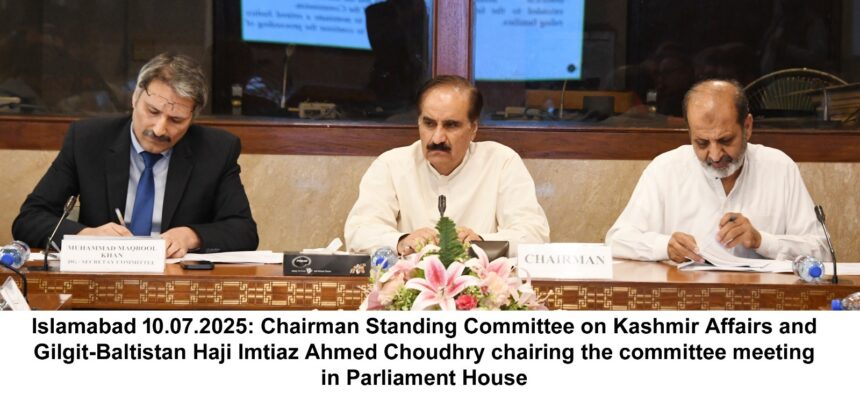
The Standing Committee of the National Assembly on Kashmir Affairs, Gilgit-Baltistan, and States and Frontier Regions convened at the Parliament House in Islamabad, under the chairmanship of Haji Imtiaz Ahmed Choudhry, to review Kashmir Affairs, Gilgit-Baltistan’s tourism development, and cross-border trade activities with China. The committee emphasized the necessity of establishing a dedicated national-level ministry or department for tourism, acknowledging its immense untapped potential and its pivotal role in driving inclusive economic growth, regional integration, job creation, and sustainable national development.
The meeting commenced with the committee formally approving the minutes from its previous session held on April 29, 2025. Subsequently, members received detailed briefings outlining the current initiatives aiming to boost tourism in Gilgit-Baltistan (GB). Representatives from the GB government presented a multi-dimensional strategy that encompasses infrastructure upgrades—including roads and airports—and establishment of Tourism Facilitation Centers. Members were also updated about the introduction of a new digital platform titled “Visit Gilgit-Baltistan,” designed to promote tourism and attract international visitors.
Officials elaborated on recent efforts encouraging private-sector investment in hospitality services, guesthouses, and eco-tourism projects. Highlighting the establishment of the Gilgit-Baltistan Tourism Development Authority (GB-TDA), officials pointed out that this institution plays an important role in streamlining regulatory processes, engaging local communities through capacity-building programs, preserving and promoting regional culture, and introducing sustainable tourism practices. Initiatives such as the creation of eco-tourism zones, improved waste management systems, and fostering cultural and adventure tourism are expected to significantly enhance the region’s appeal. As part of its strategic vision, the GB government aims to attract 1.2 million annual tourist arrivals, generate $1 billion in yearly tourism revenue, and create around 10,000 jobs by 2030.
During discussions on Gilgit-Baltistan’s role in facilitating cross-border trade with China, the committee underscored the strategic importance of the Khunjerab Pass as a critical gateway for trade. The members reviewed key trading commodities, noting that Pakistan primarily exports agricultural produce, gemstones, marble, and handicrafts, while imports predominantly consist of machinery, electronics, and construction materials. However, they expressed concern over informal trade practices which continue to result in notable tax revenue losses and inadequate regulatory oversight.
The committee was briefed about pivotal achievements in regional trade connectivity, specifically noting Pakistan’s National Logistics Corporation’s landmark trade operation under the Transports Internationaux Routiers (TIR) system. This successful operation, the first of its kind, established an international trade corridor linking Pakistan and Kazakhstan via China and Kyrgyzstan and represented effective implementation of the Quadrilateral Traffic in Transit Agreement (QTTA) under the TIR framework. Committee members appreciated this initiative as a significant step forward in promoting regional integration and economic development under the China-Pakistan Economic Corridor (CPEC).
However, concerns persisted regarding operational hurdles such as customs processing delays, duplication of immigration checks, and resulting financial losses, including forfeiture of goods. The committee acknowledged positive developments, such as recent infrastructure improvements, the establishment of green lanes for agricultural products, single-window clearance systems, and enhanced intelligence-sharing protocols, all aimed at resolving some of these long-standing trade obstacles.
To effectively address these challenges and leverage tourism as a key industry for Pakistan’s economic growth, the committee unanimously agreed on the necessity of forming a dedicated national-level tourism ministry or department. Such an entity would strengthen institutional coordination, leading to more coherent policy-making, robust promotion, and comprehensive management of Pakistan’s vast tourism potential.
The meeting was attended by honourable Members of the National Assembly including Mr. Shamsher Ali Mazari, Mr. Abdul Qadir Khan (online), Ms. Kiran Imran Dar, Mr. Fateh Ullah Khan, Mr. Naveed Aamir, Mr. Abdul Aleem Khan, Ms. Munaza Hassan, Ms. Farakh Khan, Mr. Shahzada Muhammad Gushtasap Khan, Mr. Iqbal Khan, Mian Ghous Muhammad, Mr. Anwar-ul-Haq Chaudhary (Parliamentary Secretary), and Mr. Shabbir Ahmed Usmani, Coordinator to the Prime Minister on Kashmir Affairs and Gilgit-Baltistan. Senior officials from the Ministry of Kashmir Affairs, Gilgit-Baltistan, States and Frontier Regions, as well as representatives from the Ministries of IPC, Commerce, and Interior also participated in the detailed deliberations.