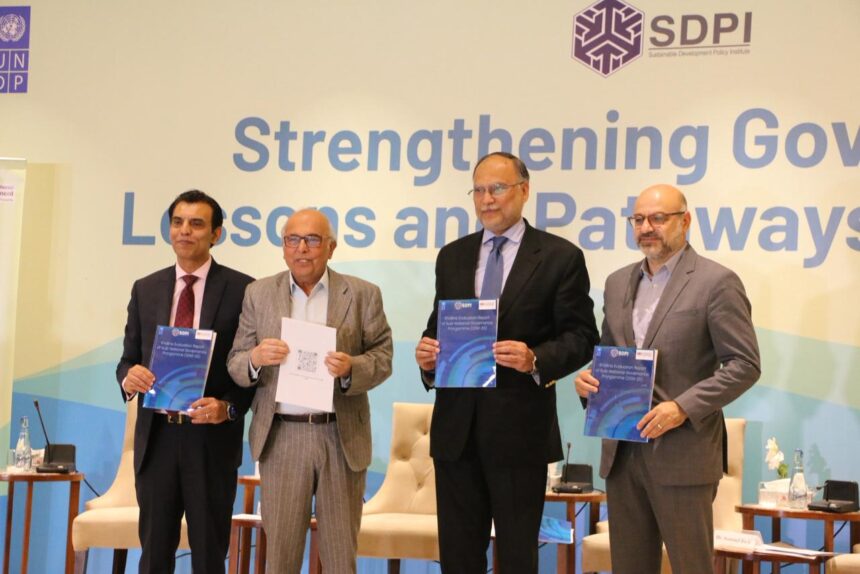
Federal Minister for Planning, Development and Special Initiatives Prof. Ahsan Iqbal urged a shift from debate to delivery on governance reforms during a high-level policy dialogue organized by UNDP and SDPI to review the Sub-National Governance Programme SNG-II.
Speaking at the event, the minister described governance as the face of the state that citizens meet daily and argued that meaningful change requires stronger provincial and local institutions. He warned that Pakistan’s transformation hinges on effective governance, not just plans, and said the country suffers from implementation and institutional weaknesses rather than a lack of policy ideas.
Prof. Iqbal highlighted everyday measures of governance such as teacher attendance, functioning Basic Health Units and timely road repairs to illustrate how governance reforms translate into real improvements for ordinary people. He also linked governance to the government’s URAAN programme, calling for system-wide, outcome-focused reforms rather than business-as-usual approaches.
On the subject of devolution, the minister said the Eighteenth Amendment was a historic step but argued devolution remains incomplete without empowered district and local governments. He stressed that provincial capitals alone cannot address the needs of remote districts and that future governance reforms must prioritize grassroots capacity alongside provincial systems.
Samuel Rizk, UNDP Resident Representative in Pakistan, welcomed SDPI’s independent evaluation of SNG-II and underscored the need to integrate governance priorities into budgeting and national planning. He emphasized local resilience and institutional ownership as critical to sustaining reforms after the programme’s close.
Dr. Abid Qaiyum Suleri of SDPI noted regional and economic pressures that require adaptive governance systems and said provincial ‘‘islands of success’’ should be scaled to produce national results. UNDP Deputy Resident Representative Van Nguyen and FCDO Group Head Matt Klensey both praised the programme’s contributions to planning, digital workflows, audit strengthening and pension reforms, highlighting innovations such as GIS mapping and local government financial reporting.
SDPI’s evaluation findings presented by Irfan Chatha recommended retaining district-level technical expertise, securing statutory backing for reforms, coordinating with provincial IT boards and institutionalizing gender and climate budget tagging. Governance expert Suleiman Ghani called for future programmes to align closely with government reform strategies to enhance ownership and sustainability.
The consultation concluded that embedded technical assistance, reform working groups and digital tools introduced under SNG-II offer practical lessons for strengthening sub-national institutions. Stakeholders were urged to convert evidence into actionable governance reforms that improve public finance management, service delivery and institutional performance across provinces and districts.