



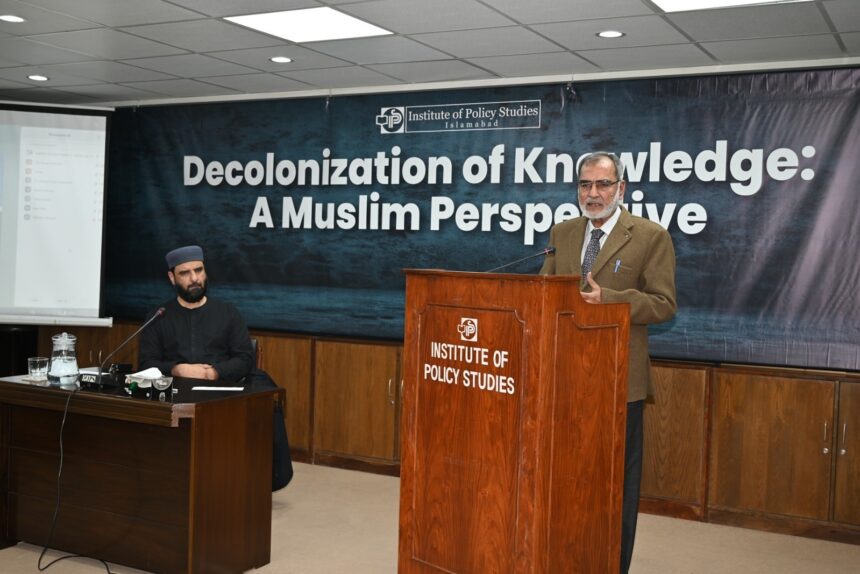
At an interactive session held at the Institute of Policy Studies in Islamabad, Dr. Ovamir Anjum, Imam Khattab Chair of Islamic Studies at the University of Toledo, urged scholars to pursue Islamic decolonization as a constructive way to engage modern challenges while remaining anchored in revelation. The workshop, titled ‘Decolonization of knowledge: A Muslim Perspective’, drew academics, researchers and students to discuss higher education, religious discourse and institutional reform in Pakistan and beyond.
Dr. Anjum clarified that Islamic decolonization does not call for abandoning modernity or returning to an imagined pre-colonial past. Instead, he described it as an intellectual effort to reclaim Islamic viewpoints and bring the Ummatic intellectual tradition to bear on contemporary questions, using the rich argumentative methods of classical scholarship to interact with modern contexts.
Critiquing some Western decolonial and postmodern approaches, he warned that discarding claims to absolute truth often produces fragmentation and incoherence. By contrast, Islamic decolonization, he argued, must remain grounded in revelation to preserve moral clarity and consistent reasoning. For Dr. Anjum the central moral antagonism in Islam is the distinction between belief and unbelief, a premise that yields a different set of priorities than secular analyses framed primarily around class or power.
Addressing the reality of working within modern universities and other ‘colonized’ institutions, Dr. Anjum maintained that no structure is completely closed to truth. He invoked the prophetic example of communicating within pre-Islamic language and customs to illustrate how religious message and fitrah, the natural disposition toward truth, can assert themselves within existing systems. This, he suggested, has practical implications for scholars operating in Pakistan’s academic and religious institutions.
On questions of tradition and progress, Dr. Anjum challenged the modern construction of ‘tradition’ used to marginalize Islamic thought and observed that the Western narrative of endless progress is increasingly under strain from environmental and existential threats. He called for renewed internal theological and intellectual dialogue rather than chasing an unattainable model of pure authenticity detached from historical mediation.
Engagement with Western critical theories such as Marxism and feminism was presented as potentially valuable so long as Muslims retain the epistemic primacy of revelation and set clear boundaries against ideas incompatible with core principles. Dr. Anjum highlighted the historical breadth and dialogical spirit of the Islamic tradition while insisting on maintaining its essential commitments.
Pointing to reforms needed in educational and religious institutions, he emphasized that the Qur’an and Sunnah should not be treated as secondary or symbolic references. Rather, Pakistan’s seminaries and universities should revive the classical method of presenting multiple viewpoints with evidence, fostering intellectual depth and avoiding sectarian polemics.
In closing remarks, Khalid Rahman, chairman of IPS, said that decolonization requires a deeper understanding of colonialism and imperialism as ongoing processes and affirmed IPS’s commitment to further debate and collaboration with academic partners. The workshop underscored Islamic decolonization as a practical project with direct relevance to Pakistani scholarship and institutional reform.