



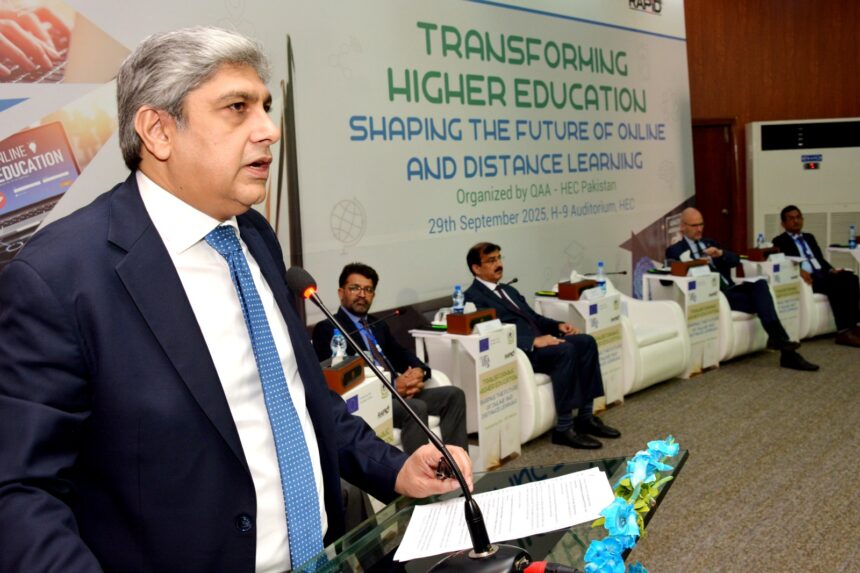
The Higher Education Commission’s Quality Assurance Agency convened a summit at the HEC Secretariat in Islamabad to advance online education standards across Pakistan under the Erasmus+ CBHE RAPID project, in collaboration with Sukkur IBA University and international partners.
The event brought together national and international experts, policymakers and academics to align online education practices with international quality assurance norms. Funded by the European Union under Erasmus+ CBHE, the initiative aims to strengthen institutional learning, foster global collaboration and inform national policy on distance and online learning.
Nadeem Mahbub, Chairman HEC, described the meeting as an opportunity to rethink how education is delivered, assessed and assured in Pakistan. He underlined that online education must expand equitable access to higher education across the country’s diverse geography, including underserved and remote regions, and stressed that technology should enhance quality rather than replace it.
Dr Zia Ul-Qayyum, Executive Director HEC, highlighted the need to adapt European best practices to local contexts and called for collective ownership by universities, regulators and international partners to build a resilient digital higher education system supported by robust quality assurance mechanisms.
Philipp Gross, Chargé d’Affaires of the European Union Delegation to Pakistan, said the summit marks a milestone in digital innovation and resilience for higher education. He reiterated the EU’s support for faculty capacity building, infrastructure improvements in remote universities and sustained cooperation, noting Pakistan’s strong record in Erasmus initiatives.
RAPID project leaders from Sukkur IBA underlined the accelerating role of online education following COVID-19 and the advent of generative AI. Project coordinators reported that over 400 faculty members have been trained through webinars, seminars and regional workshops, while 45 faculty benefited from mobility programs in Italy, Sweden and Norway. Work is underway to establish digital infrastructure in universities in Baltistan and Balochistan and a Policy Advisory Committee is refining Pakistan’s Open and Distance Learning framework.
Technical presentations at the summit included international perspectives on pedagogy and technology with speakers such as Dr Nicole Veelo from NTNU on technological pedagogical content knowledge, Dr Mexhid Ferati of Linnaeus University on hybrid delivery, and Prof Paolo Bottoni of Sapienza University on managing remote learning. A presentation on ODL policy was delivered by Abaidullah Anwar, followed by national sessions addressing implementation hurdles and policy gaps.
Nasir Shah, Director General QAA, thanked participants and partners and noted remaining gaps in infrastructure, curriculum and faculty training. He said the summit’s recommendations will guide actionable reforms so that online education becomes a driver of inclusion and innovation in Pakistan. The proceedings, outcomes and recommendations will be compiled and shared with the European Commission, partner universities and relevant HEC divisions to inform national policy refinement.