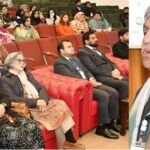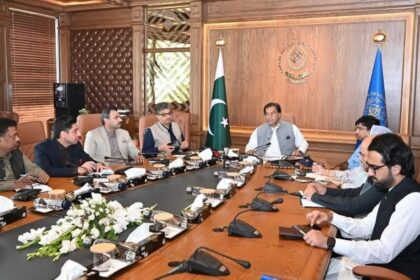




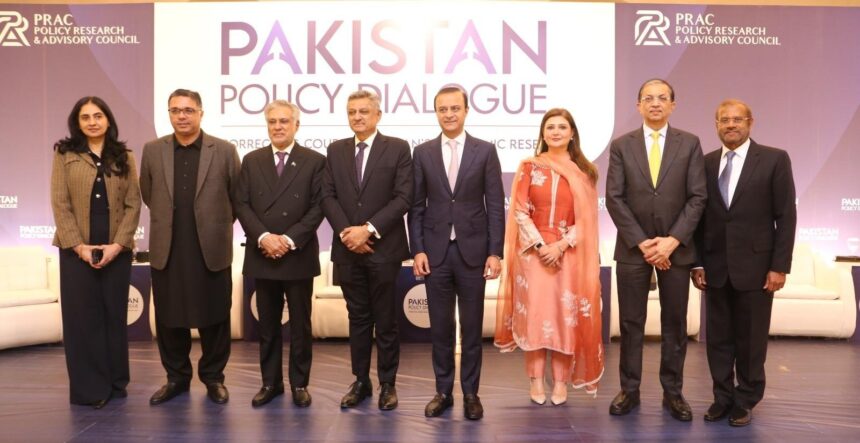
In Islamabad, Deputy Prime Minister and Foreign Minister Senator Muhammad Ishaq Dar urged sustained policy continuity and institutional discipline as the foundation for Pakistan’s economic reset, telling senior policymakers and business leaders that technology-enabled governance must translate policy intent into measurable outcomes.
Speaking at the Pakistan Policy Dialogue organized by the Policy Research and Advisory Council in partnership with Corporate Pakistan Group and Nutshell Group, with the Ministry of Commerce and TDAP as founding partners, Mr Dar said diplomatic efforts are being aligned to help businesses boost exports and forge partnerships rooted in economic interests.
Participants welcomed the push for a pragmatic economic reset that balances short-term stabilization with longer-term development. Federal Minister for Planning Prof Ahsan Iqbal stressed the need for stronger planning, higher productivity and export competitiveness, observing that Pakistan must adopt a future-forward approach instead of reverting to past narratives to drive progress.
Senator Muhammad Aurangzeb, the finance minister, outlined government priorities on macroeconomic stability and formalizing emerging sectors. He said addressing population growth and climate risks is essential for sustainable growth, while new areas such as crypto and blockchain require regulation and an enabling ecosystem for youth and freelancers.
Senator Dr Musadik Malik highlighted equitable resource distribution, urging democratization of capital so women and new graduates can participate meaningfully. Adviser Muhammad Ali urged accelerated privatization, noting that private enterprise should handle activities better suited outside the public sector to free up stretched resources and increase inclusion.
Renowned economist Dr Ishrat Husain argued for a paradigm shift toward services exports and human capital development, noting technology has made services growth outpace goods and that Pakistan must adapt to capture those opportunities as part of its economic reset.
PRAC chairman Muhammad Younus Dagha outlined recent macro improvements and cautioned that sustaining gains depends on preparedness for future disruptions such as AI. He cited falling inflation, rising foreign exchange reserves and a current account surplus as signs of progress, but called for coherent, predictable policy to build investor confidence and develop AI-ready skills and productive cities.
Panel discussions reinforced the focus on digitization, green finance and competitiveness. In the session on bridging the digital divide, industry leaders called for a push toward a cashless economy, ubiquitous QR payments and stronger government digitization to boost financial inclusion and investor perceptions.
The green growth session emphasised mobilizing private capital through instruments such as green bonds, sukuk, carbon finance and debt-for-climate swaps, while UNDP and private sector speakers urged nationally led climate strategies and innovative tools like tokenization to broaden investor access for decarbonization and water‑security projects.
On competitiveness, government advisers described tariff and customs reforms phased over multiple years to attract investment and improve efficiency. Private sector leaders highlighted a dual reality in Pakistan: traditional economic challenges alongside a vibrant startup and SME ecosystem that can drive jobs and exports.
Closing remarks from industry figures stressed that sustained collaboration between the state and private sector, backed by evidence-based policy and structural reforms, is essential to convert dialogue into delivery. The Dialogue concluded with consensus on deepening partnerships between policymakers, business leaders, financial institutions and development partners to advance Pakistan’s economic reset in the months ahead.