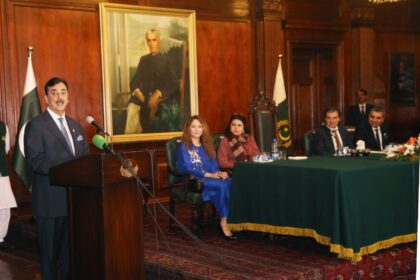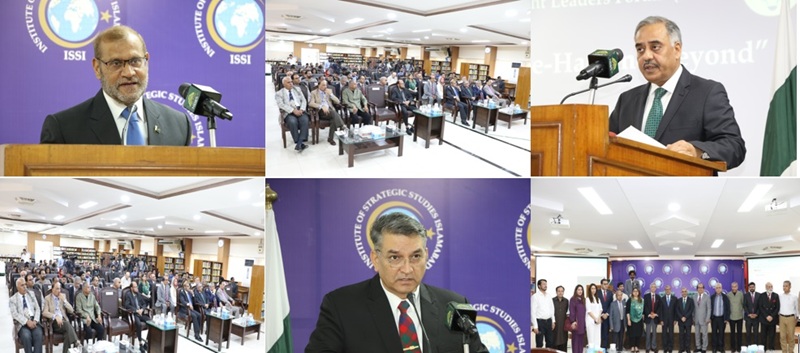
Former Chief of Air Staff, Air Chief Marshal (Retired) Sohail Aman addressed the Institute of Strategic Studies Islamabad (ISSI) on the topic of “Marka-e-Haq and Beyond,” highlighting Pakistan’s successful defense against Indian military aggression and the broader implications for regional security and diplomacy in South Asia.
Director General ISSI, Ambassador Sohail Mahmood, opened the session by describing “Marka-e-Haq” as a powerful demonstration of Pakistan’s determination to defend its sovereignty and territorial integrity in the face of Indian military operations. He attributed the crisis to a mix of Hindutva ideology and political motives within India, combined with overconfidence in its military capabilities. Ambassador Mahmood underscored Pakistan’s success across diplomatic, military, and informational domains during the conflict, noting the Pakistan Air Force’s (PAF) crucial role, including the downing of at least six Indian fighter jets in what is considered the largest air battle in history.
He detailed Pakistan’s military response, “Operation Bunyan-um-Marsoos,” which marked a significant shift towards integrated multi-domain warfare by incorporating advanced drone operations, precision strikes, cyber capabilities, and unified command structures. While emphasizing Pakistan’s achievements, Ambassador Mahmood warned that the situation remains tense as India continues to pursue its objectives through different means and maintains a misperception that there is room for limited conventional conflict under the nuclear threshold, an assumption he said needs to be corrected for regional stability. He stressed the necessity for ongoing vigilance, military modernization, and proactive diplomacy to deter future aggression and promote lasting peace in the region.
Air Chief Marshal Sohail Aman, in his address, criticized what he described as an international disconnect between efforts for peace and India’s continued pursuit of confrontation with Pakistan. He emphasized that it was a mistake for anyone to assume Pakistan would not respond robustly to Indian military actions and described “Marka-e-Haq” and “Operation Bunyan-um-Marsoos” as marking a transformation in Pakistan’s defense strategy, with innovative use of air power, precision attacks, and cyber warfare. Aman challenged India’s narrative that it faced a combined China-Pakistan force, dismissing it as an attempt at face-saving, and asserted that the technologically advanced Pakistan Air Force decisively outperformed its larger Indian rival. While nuclear deterrence was maintained, he warned of the risk of uncontrolled escalation if clear boundaries are not respected, reiterating the importance of dialogue, diplomacy, and resolution of long-standing disputes such as Kashmir for durable peace. He also called for prioritizing economic development, stability, and regional connectivity.
Dr. Talat Shabbir, Director of the China-Pakistan Study Centre, noted the timeliness of the discussion and highlighted that unified national strength, political leadership, and public support were critical to Pakistan’s success during “Marka-e-Haq.”
Participants from the diplomatic, academic, and policy sectors engaged in a lively discussion on the evolving dynamics of warfare, regional security, and strategies for sustained peace and stability in South Asia. The session concluded with a presentation of a memento to Sohail Aman and underscored the importance of continued dialogue on strategic issues in the region.