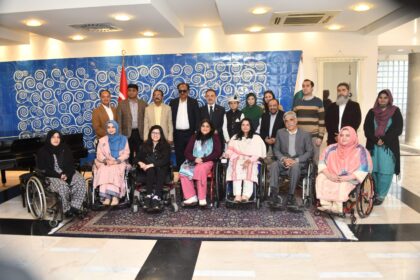





Maryam Nawaz’s Bold Leadership: Historic Action Against Institutional Negligence Shaista Khan Jadoon, MNA
by (Talia Noorulain Khan)
Islamabad: The tragic death of a mother and daughter who fell into an open manhole at Bhati Gate, Lahore, was not merely a devastating incident for one family; it raised serious questions about collective conscience and institutional performance. Such tragedies are not isolated accidents but the result of years of negligence, weak monitoring, and absence of accountability. In this backdrop, the timely, courageous, and extraordinary action taken by Punjab Chief Minister Maryam Nawaz Sharif signals that Punjab has entered an era of decisive governance rather than hollow statements.
These views were expressed by Shaista Khan Jadoon, Member of the National Assembly, while speaking exclusively to media representatives. She said she strongly appreciated the Chief Minister’s historic decisions, terming them exemplary measures which, had they been adopted in the past, could have saved the country from much of the corruption, irresponsibility, and incompetence entrenched in public institutions. Maryam Nawaz, she said, has demonstrated that authority is a public trust and that there will be no leniency for those who betray it.
Shaista Khan Jadoon highlighted the high-level meeting chaired by the Chief Minister following the incident, where responsible officers were held directly accountable. She referred to Maryam Nawaz’s firm response to a routine apology by an official—“Will your apology bring the mother and daughter back to life?”—calling it a defining moment that marked the end of symbolic apologies and institutional indifference.
She further noted that the Chief Minister ordered the recovery of Rs100 million from the contractor found responsible, to be paid to the bereaved family. Additionally, the arrest of five individuals, their permanent dismissal from service, and their disqualification from future government employment were described as unprecedented but necessary decisions. These actions, she said, send a strong message that human life in Punjab will no longer be treated as a mere statistic or file entry.
Shaista Khan Jadoon observed that in similar incidents, institutions usually evade responsibility by shifting blame among municipal bodies, contractors, supervisory departments, and police. However, Maryam Nawaz broke this pattern by asserting that safeguarding public life and property is a collective responsibility of the state. Her directive to ensure the strictest punishment for criminal negligence reflects this shift in governance.
She also pointed to the police conduct in the Bhati Gate incident, which came under strict notice. Reports of detaining and allegedly mistreating the victim’s husband and brother-in-law during the rescue call were termed illegal and indicative of deep-rooted flaws in policing culture. On the Chief Minister’s directives, SHO Bhati Gate Zain Abbas was suspended, a show-cause notice was issued to the DSP, and a high-level inquiry was announced under SP City supervision. The DIG Operations’ decision to refer the matter to the Internal Accountability Bureau for independent investigation was termed a positive step, contingent upon strong political backing.
According to Shaista Khan Jadoon, Maryam Nawaz’s leadership has restored public confidence that these investigations will not remain a formality but will reach their logical conclusion. She emphasized that institutional reform requires more than suspensions—it demands political resolve, clear policy direction, and sustained oversight. The Chief Minister’s instruction to complete investigations promptly and take strict action against all responsible officials reflects that resolve.
She further stated that institutions in Pakistan often remain influenced by powerful interests, forcing ordinary citizens to struggle for justice. Maryam Nawaz’s decisions have challenged this perception, clearly conveying that neither contractors nor officers are above accountability. This approach, she said, strengthens the state.
Shaista Khan Jadoon added that had similar decisive steps been taken earlier, open manholes, broken infrastructure, and deadly negligence would not have become routine. The suffering caused by institutional failure can only be addressed through fearless political leadership—something Maryam Nawaz has demonstrated by refusing to bow to pressure or compromise on public interest.
Responding to criticism labeling these actions as “political point-scoring,” she questioned whether protecting human life or punishing negligence could truly be called politics. If so, she said, it is a politics worth embracing. The public now demands results, not slogans, and Maryam Nawaz’s actions represent a meaningful step in that direction. She expressed hope that similar bold measures would also be adopted in Khyber Pakhtunkhwa.
Concluding her remarks, Shaista Khan Jadoon said the message sent from Punjab against administrative negligence offers hope that such tragedies will not be repeated. When contractors know negligence carries severe financial and professional consequences, and officers realize apologies are insufficient, governance will begin to correct itself. She paid tribute to Chief Minister Maryam Nawaz Sharif for not only fulfilling her constitutional role but also empathizing with the people like a mother. Holding institutions accountable, she said, is the true test of leadership—and if this path continues, Punjab can emerge as a safer, more responsible, and accountable province.
Read in Urdu: مریم نواز کی جرآت مندانہ قیادت، ادارہ جاتی غفلت کے خلاف تاریخ ساز اقدامات