



National Security Workshops Redefine Pakistan’s Non-Kinetic Approach to Modern Security
By: Azfereen Baloch
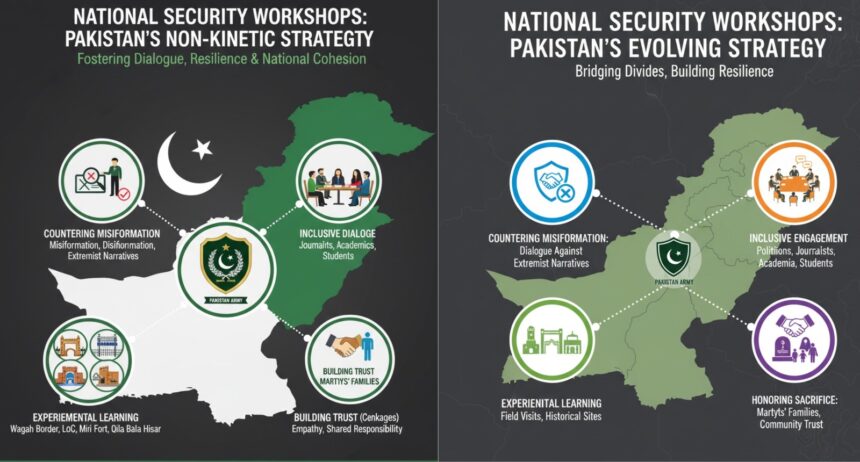
In an era where national security challenges are no longer confined to conventional battlefields, Pakistan’s evolving approach toward non kinetic measures reflects a thoughtful and mature understanding of the complexities of modern statecraft. Among these initiatives, a series of National Security Workshops conducted collaboratively by Pakistan Army and the Government of Balochistan and the Government of Khyber Pakhtunkhwa emerge as a meaningful investment in dialogue, perception management, and intellectual resilience. Supported by the sustained efforts of Corps 11 and Corps 12, these workshops represent a sincere attempt to narrow the distance between state institutions and society while constructively addressing misinformation, disinformation, and extremist narratives.
What distinguishes these workshops is not only their inclusivity but also the depth of engagement they encourage. Participants are drawn from diverse segments of society politicians, journalists, media professionals, civil administrators, bureaucrats, academics, and students ensuring a genuinely multidimensional exchange of perspectives. This diversity transforms the workshops into a living forum where experiences, concerns, and ideas intersect. Interaction extends well beyond peer discussion, as participants engage directly with highly qualified guest speakers, including federal and provincial ministers, ambassadors, senior military officials, and subject matter experts. These exchanges are characterized by openness, respect, and intellectual rigor, enabling participants to question assumptions and, importantly, to distinguish between myths, perceptions, and lived realities.
A defining strength of these workshops lies in their emphasis on experiential learning. Thoughtfully planned field visits expose participants to the operational realities of national security. Visits to strategic locations such as the Wagah Border in Lahore and the Line of Control in Muzaffarabad provide firsthand insight into border management, ceasefire mechanisms, and the enduring challenges of maintaining peace under persistent pressures. These encounters quietly underscore the delicate balance between deterrence and restraint, while drawing attention to the human cost of conflict and the enduring value of stability, restraint, and harmony.
Equally significant are the visits dedicated to honouring the sacrifices of Pakistan’s security forces. Interactions with the families of martyrs (shahada) serve as a deeply human reminder of the personal cost borne in the service of collective security. These moments encourage reflection and empathy, inviting participants to confront an uncomfortable reality: that public discourse often moves forward without fully acknowledging the sacrifices that sustain peace. Such engagements do more than pay tribute; they nurture a renewed sense of responsibility to engage thoughtfully and respectfully in national conversations.
Historical awareness forms another important pillar of the workshop design. Visits to museums, forts, and heritage sites such as Miri Fort and Qila Bala Hisar connect participants with the historical layers of the regions they inhabit. These places, shaped by centuries of conflict and coexistence, reinforce the understanding that contemporary security challenges are deeply rooted in historical experience. By anchoring discussion in historical continuity, the workshops encourage a measured, long term perspective on regional and national security.
Crucially, interactions with senior leadership, including meetings with the Prime Minister and the Chief of Army Staff, elevate these workshops beyond symbolic engagement. Such access provides a rare and valuable interface between top level decision makers and grassroots intellectuals. Participants are encouraged to raise questions on pressing national concerns ranging from economic stability and governance to internal security and regional dynamics and receive direct, unfiltered responses. This culture of early engagement and transparent dialogue helps strengthen institutional trust and reinforces the principle of accountability.
The role of the Frontier Corps, particularly through engagement with the leadership of IG FC North and South, further enriches participants’ understanding of cross border realities. Detailed briefings on arms proliferation, drug trafficking, human trafficking, and cross border militancy reveal the interconnected nature of modern security threats. These discussions move beyond simplistic narratives, highlighting the importance of coordinated responses rooted in cooperation, awareness, and community engagement.
Perhaps the most enduring contribution of these workshops lies in their openness to feedback. Participants are not treated as passive audiences; their proposals, recommendations, and policy suggestions are actively welcomed, documented, and reviewed. The consideration of these insights in future planning reflects an understanding that sustainable security cannot be shaped solely from the top it must evolve through informed participation and collective ownership.
Taken together, these National Security Workshops demonstrate how non kinetic measures can effectively complement traditional security strategies. By addressing youth radicalization, countering misinformation, and fostering informed patriotism, they contribute to shaping responsible, critically aware citizens. In doing so, they help recalibrate national narratives, replacing skepticism and distance with realism, resilience, and shared responsibility.
In a world increasingly influenced by information warfare and ideological polarization, Pakistan’s experience offers a thoughtful case study. Security, these workshops quietly affirm, is not only about safeguarding borders it is equally about shaping minds, encouraging dialogue, and cultivating a society capable of distinguishing truth from distortion. Through sustained commitment and inclusive engagement, such initiatives lay the groundwork for a more cohesive, confident, and resilient nation.
National Security Workshops emerge as a quiet but meaningful corrective to long standing misunderstandings surrounding Khyber Pakhtunkhwa and Balochistan. The discussions reveal that many of the region’s challenges do not originate from a single cause but stem from a layered mix of historical neglect, uneven development, weak governance linkages, identity anxieties, cross-border spill overs, and the space created by misinformation and external manipulation. By bringing diverse societal voices into direct, respectful dialogue with state institutions, the workshops help replace inherited narratives of alienation with informed understanding and shared responsibility. Their most tangible outcome lies in rebuilding trust between center and periphery, state and citizen while equipping participants to act as informed intermediaries within their own communities. The path forward, as these engagements suggest, does not lie solely in force or rhetoric, but in sustained inclusion, honest acknowledgment of grievances, improved service delivery, economic opportunity, and continuous communication. In this sense, the workshops do not claim to resolve the issues of KP and Balochistan overnight; rather, they lay the intellectual and social groundwork for solutions rooted in empathy, realism, and collective ownership an approach essential for durable peace and national cohesion.